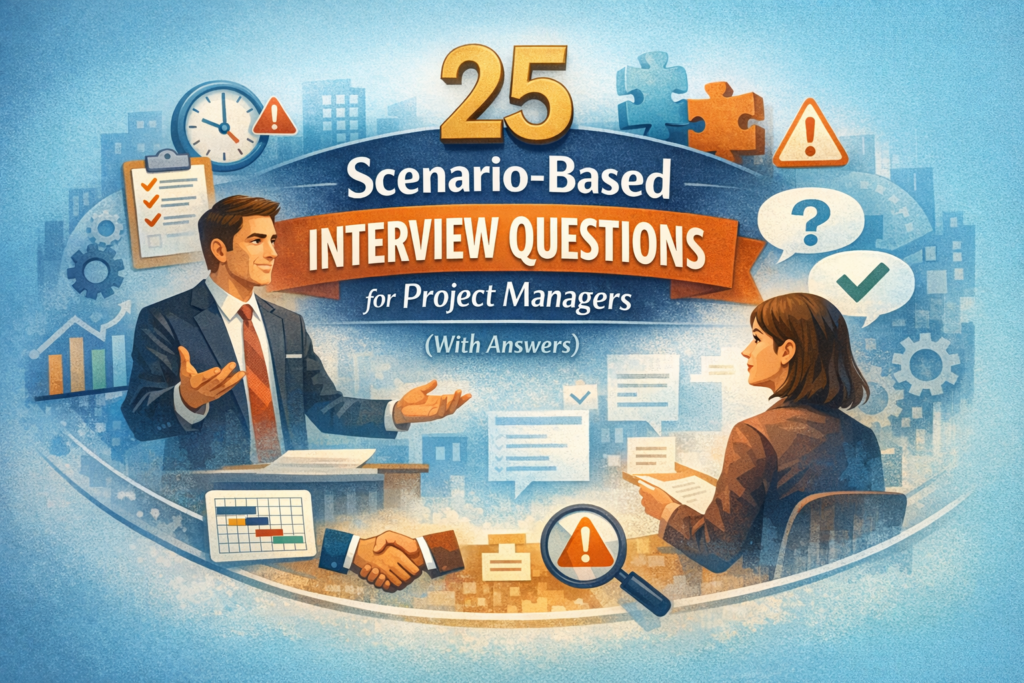
Scenario-Based Interview Questions for Project Managers have become the centerpiece of most PM interviews — and for good reason. Rather than asking what you’ve done, they ask what you would do, dropping you into the exact situations that define the job: a timeline slipping, a stakeholder reversing their own requirements, a budget that just shrank, scope creeping past its banks, a team fracturing at the worst possible moment.
This is what separates them from behavioral questions. Behavioral questions look backward at your track record; scenario questions look forward at your judgment. When an interviewer describes a project drifting off schedule and asks how you’d respond, they’re not grading the answer itself — they’re watching how you think. What do you prioritize first? What do you say to whom, and in what order? Where do you stay calm and where do you push? A single hypothetical exposes your instincts for leadership, decision-making, communication, stakeholder management, and risk — often more honestly than a rehearsed success story ever could.
The strongest answers share a shape: they diagnose before they act, they weigh trade-offs out loud, they name the outcome they’re steering toward, and they close the loop. Frameworks like the STAR method or a simple problem-solving structure help, but only as scaffolding — the substance is your reasoning, not the acronym.
This guide walks through the scenario questions Project Managers hear most, with sample answers, the thinking behind each one, and the strategies that turn a good response into a memorable one — so the toughest question in the room becomes the one you’re most prepared to own.
For the ground-up version — everything from fundamentals to interview-day strategy — start with Gururo’s Project Manager Interview Preparation Guide, then dive into the tips below.

What Are Scenario-Based Interview Questions?
Scenario-based interview questions present hypothetical situations that project managers may encounter during a project.
Interviewers use these questions to understand how candidates:
- analyze complex situations
- prioritize tasks and decisions
- communicate with stakeholders
- manage project risks
For example, an interviewer might ask:
“What would you do if your project is falling behind schedule?”
Rather than looking for a single “correct” answer, interviewers want to evaluate the candidate’s approach to problem solving and leadership.
Scenario questions are particularly common in project management roles because projects often involve uncertainty, cross-functional teams, and changing requirements.
Understanding scenario based interview questions for project manager roles helps candidates prepare structured and effective responses.
To review additional interview questions, see:
project-manager-interview-questions
Why Employers Ask Scenario-Based Questions in Project Manager Interviews
Scenario-based questions help employers assess whether candidates can apply project management principles in real situations.
These questions help interviewers evaluate several important skills.
Employers rely on scenario based interview questions project manager interviews use to assess real-world decision-making abilities. According to the Project Management Institute, effective project managers must apply structured processes, leadership skills, and risk management techniques to deliver successful outcomes.
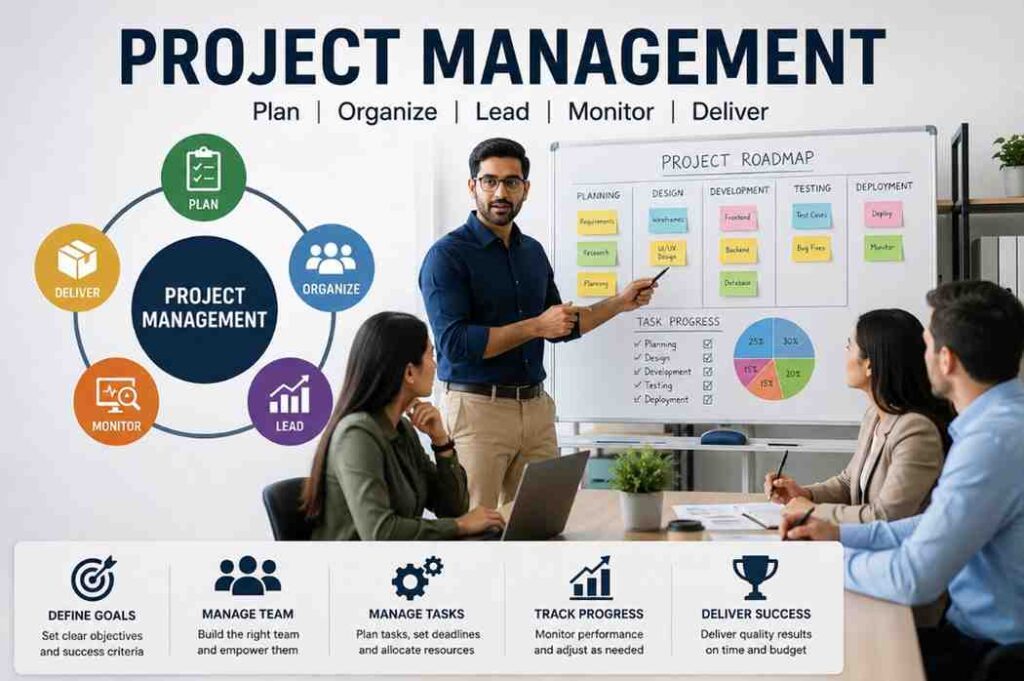
Critical Thinking
Project managers must analyze complex problems and develop practical solutions.
Leadership
Candidates should demonstrate how they guide teams through challenges.
Stakeholder Management
Projects often involve multiple stakeholders with different expectations.
Decision Making Under Pressure
Scenario questions reveal how candidates respond to urgent project issues.
While scenario questions focus on hypothetical situations, behavioral questions focus on past experiences.
To prepare for those questions, see:
Behavioral-project-manager-interview-questions
Common Scenario-Based Interview Questions for Project Managers
Below are the most important scenario based interview questions for project managers asked in interviews.
Common situational interview questions include:
- What would you do if your project falls behind schedule?
- How would you handle a stakeholder requesting major changes late in the project?
- What would you do if your team member is underperforming?
- How would you manage a conflict between two team members?
- What would you do if a project risk suddenly becomes a major issue?
Preparing structured responses to these questions will help you demonstrate leadership and decision-making ability.
What Would You Do If a Project Is Falling Behind Schedule?
Why interviewers ask this question
Schedule delays are one of the most common challenges in project management. Interviewers want to see how candidates analyze the situation and recover the schedule.
How to approach the situation
A strong answer should include:
- identifying the root cause of delays
- developing a recovery plan
- communicating with stakeholders
Example answer
If a project falls behind schedule, my first step is to identify the root cause of the delay. I review the project plan and speak with team members to understand where the bottleneck occurred.
Next, I evaluate options for schedule recovery, such as reallocating resources, running tasks in parallel, or adjusting priorities.
Finally, I communicate the updated plan with stakeholders and ensure the team understands the revised expectations. This structured approach helps minimize delays while maintaining transparency.This is one of the most common scenario based interview questions project manager candidates face in interviews.
What Would You Do If a Stakeholder Requests Major Changes Late in the Project?
Why interviewers ask this question
Stakeholders may request changes even during the final stages of a project.
How to approach the situation
Candidates should demonstrate knowledge of change control processes.
Steps include:
- evaluating the impact on scope, schedule, and budget
- discussing the change request with stakeholders
updating project plans if the change is approved
Example answer
If a stakeholder requests major changes late in the project, I first assess the impact of the change on scope, timeline, and resources.
I then discuss the request with stakeholders to understand the priority and business value. If the change is essential, I follow the change control process and update the project plan accordingly.
Clear communication ensures stakeholders understand the impact of the change before it is approved.
For more examples of stakeholder scenarios, see:
Stakeholder-management-interview-questions
What Would You Do If Two Team Members Have a Conflict?
Why interviewers ask this question
Team conflicts can disrupt project productivity and collaboration.
How to approach the situation
Effective answers should demonstrate:
- mediation
- communication
- leadership
Example answer
If two team members have a conflict, I first meet with each person individually to understand their perspective.
Next, I facilitate a discussion where both team members can openly discuss the issue and focus on the project goals rather than personal differences.
By encouraging open communication and finding common ground, I help resolve the conflict and ensure the team can continue working effectively.
For additional leadership examples, visit:
leadership-interview-questions
What Would You Do If a Team Member Is Underperforming?
Why interviewers ask this question
Project managers must ensure that team members meet project expectations.
How to approach the situation
A strong answer should include:
- identifying the cause of the performance issue
- providing support or coaching
- setting clear expectations
Example answer
If a team member is underperforming, I first try to understand the root cause. The issue could be related to workload, unclear expectations, or personal challenges.
I then discuss the issue with the team member and provide guidance or additional support if necessary. By setting clear expectations and monitoring progress, I help the team member improve performance while maintaining team morale.
What Would You Do If a Major Project Risk Becomes an Issue?
Why interviewers ask this question
Risk management is a core responsibility of project managers.
How to approach the situation
Candidates should demonstrate knowledge of risk response strategies.
Key steps include:
- activating the risk response plan
- implementing mitigation actions
communicating with stakeholders
Example answer
If a major risk becomes an issue, I immediately review the risk response plan developed during project planning.
I coordinate with the team to implement mitigation actions and assess the impact on the project schedule and scope.
At the same time, I inform stakeholders about the situation and provide updates on the actions being taken to manage the risk.
Project Delay Scenario Questions
Interviewers often ask questions related to project delays.
Examples include:
- What would you do if your project deadline is at risk?
- How would you recover a delayed project schedule?
- What steps would you take if tasks are taking longer than expected?
Candidates should demonstrate:
- schedule analysis
- resource reallocation
- stakeholder communication
More examples can be found in:
project-manager-interview-questions
Stakeholder Conflict Scenario Questions
takeholder conflicts are common in complex projects.
Examples include:
- What would you do if stakeholders disagree on project priorities?
- How would you handle conflicting stakeholder expectations?
- What would you do if a client requests unrealistic changes?
Effective answers should focus on communication, negotiation, and alignment.
Handling such situations is a key part of scenario based interview questions for project managers.
For more examples, visit:
Stakeholder-management-interview-questions
Scope Change Scenario Questions
Scope changes often occur during projects.
Interviewers may ask questions such as:
- How would you handle scope changes during a project?
- What would you do if project requirements change suddenly?
- How would you manage scope creep?
Candidates should demonstrate knowledge of change management processes.
Team Management Scenario Questions
Team management scenarios evaluate leadership and collaboration.
Examples include:
- How would you handle low team morale?
- What would you do if team members are missing deadlines?
- How would you manage a distributed project team?
Strong answers should highlight leadership, communication, and problem solving.
This type of issue frequently appears in scenario based interview questions project manager interviews include.
Tips for Answering Scenario-Based Interview Questions

Here are several strategies for answering situational interview questions effectively.
1. Clarify the Scenario
If necessary, ask clarifying questions before answering.
2. Explain Your Decision-Making Process
Interviewers want to understand how you think through complex problems.
3. Focus on Stakeholder Communication
Successful project managers communicate clearly with stakeholders.
4. Demonstrate Leadership
Show how you guide teams through challenges.
5. Highlight Risk Management
Explain how you identify and mitigate risks.
For additional preparation tips, see:
project-manager-interview-tips
&
project-manager-interview-preparation-guide
Practice Scenario-Based Questions With a Mock Interview
Scenario-based interviews are often the most challenging part of project manager hiring processes because they require candidates to think quickly and demonstrate leadership.
Practicing with a mock interview can help candidates:
- simulate real interview situations
- receive expert feedback
- improve structured responses
- gain confidence before the actual interview
Don’t just read the questions — master them. Gururo’s Project & Program Case Study Interview Preparation puts you in front of real case scenarios so you walk into the room ready to lead, not improvise.
Frequently Asked Questions
What are scenario-based interview questions for project managers?
Scenario-based interview questions present hypothetical project situations and ask candidates how they would respond.
How should I answer situational interview questions?
Candidates should explain their thought process, describe the steps they would take, and highlight communication with stakeholders.
Why do employers ask scenario-based questions?
These questions help employers evaluate decision-making ability, leadership skills, and problem-solving approaches.
What is the difference between behavioral and scenario interview questions?
Behavioral questions focus on past experiences, while scenario questions ask how candidates would handle hypothetical situations.
What are scenario-based interview questions for Project Managers?
They are hypothetical workplace situations used to assess how candidates would respond to real project management challenges.
Are scenario-based questions common in Project Manager interviews?
Yes. Most organizations use them to evaluate leadership, decision-making, and problem-solving skills.
How many scenario-based questions should I prepare for?
Preparing 20–30 common scenarios is usually sufficient for mast Project Manager and Senior Project Manager interviews.
Final Thoughts
Scenario-based questions have quietly become the deciding factor in most Project Manager interviews. Certifications and frameworks get you into the room — but what earns the offer is proof that you can apply them when a project is on fire and the answers aren’t obvious.
That’s exactly what these questions test. A stalled timeline, a stakeholder who won’t stop moving the goalposts, a budget bleeding out, a team quietly coming apart — how you talk through moments like these reveals more about your leadership, judgment, and composure than any line on your résumé. A structured, thoughtful answer signals that you don’t just know project management; you can do it under pressure.
Working through these 25 questions isn’t about scripting perfect responses. It’s about internalizing the principles beneath them, so that whatever scenario an interviewer invents, you have a reliable way to think it through out loud. A consistent approach — the STAR method, anchored in real examples and measurable outcomes — is what separates a candidate who sounds capable from one who clearly is.
Whether the title on the door says Project Manager, Senior Project Manager, Program Manager, or Delivery Manager, the skill being measured is the same: can you steer complexity toward a result? Master these scenarios, sharpen the stories behind your best work, and walk in ready to show it — not just claim it.