
Interview Prep
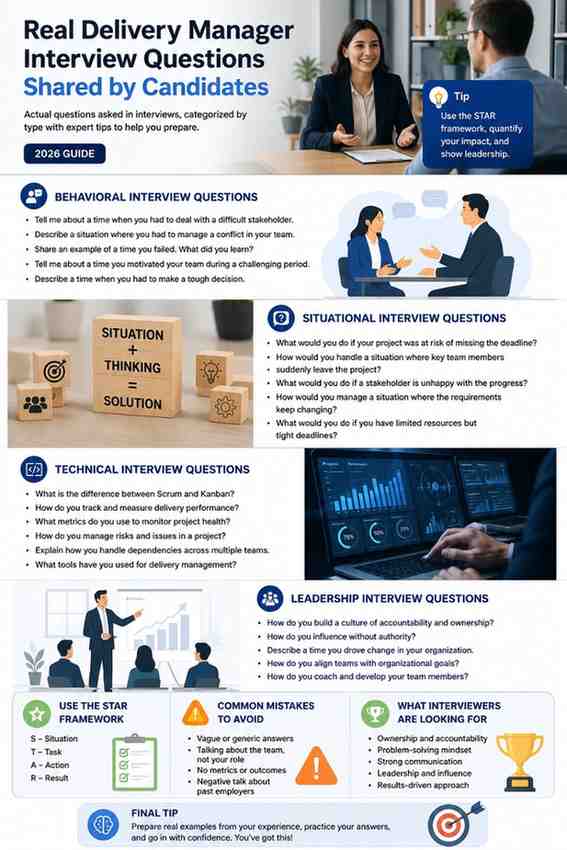
Real Delivery Manager Interview Questions Shared by Candidates
shreya22.gururo@gmail.com
Updated 24 Oct 2026
8 min read
✓ 1:1 interview coaching available
On this page
Delivery Manager Interview Questions Shared by Candidates
If you are preparing for a Delivery Manager interview, you already know the stakes are high. This guide brings together real Delivery Manager interview questions shared by actual candidates — along with expert-backed tips, sample answers, and the structured preparation approach that Gururo recommends to its learners.
For hands-on practice, our program manager interview preparation includes a hiring-style interview and a competency scorecard, covering the same leadership skills delivery manager panels test.
Delivery Managers sit at the intersection of technology, people, and process. Interviewers want proof that you can drive projects to completion, manage complex stakeholder expectations, resolve blockers quickly, and lead diverse teams through uncertainty. Whether you are applying for a role at a global consulting firm, a product company, or a government digital service, the core themes remain consistent.
This guide is built on patterns from hundreds of interview debrief sessions and candidate-shared experiences compiled by the Gururo platform. Use it to sharpen your preparation and walk into your next panel with genuine confidence.
Table of Contents
What Does a Delivery Manager Actually Do?
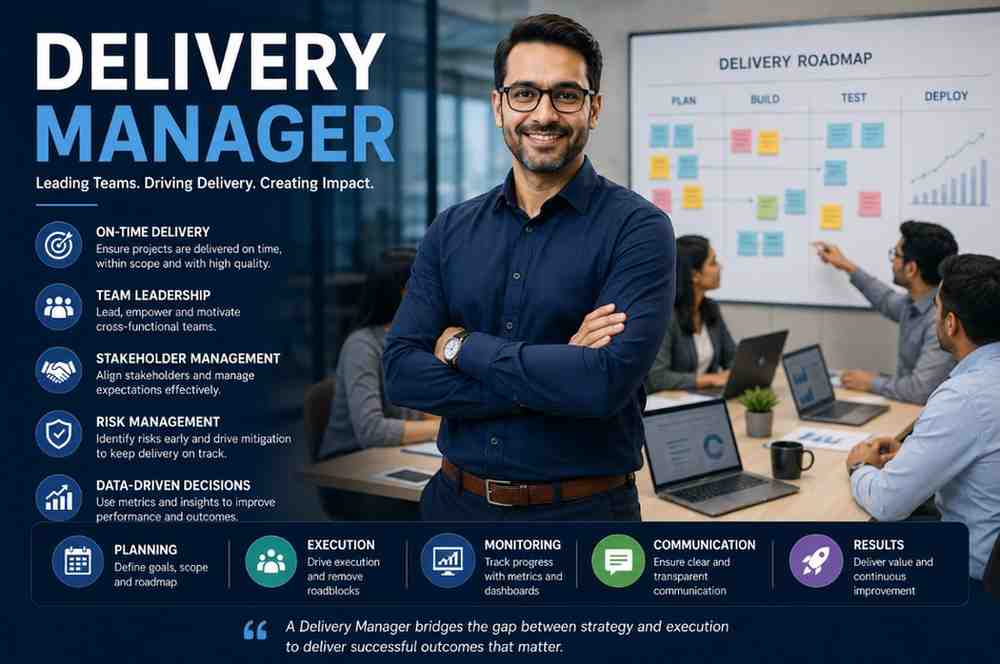
Before diving into questions, it helps to see the role clearly. A Delivery Manager is responsible for the end-to-end delivery of software products, IT services, or transformation programmes. Unlike a pure project manager who works to a plan, a Delivery Manager works in dynamic environments where priorities shift, teams are cross-functional, and delivery must be continuous.
Core responsibilities include facilitating agile ceremonies, managing risks and dependencies, unblocking teams, building relationships with senior stakeholders, tracking velocity and quality metrics, and constantly improving the delivery process. Interviewers assess all of these dimensions.
“The best Delivery Managers are not just project trackers — they are servant leaders who create the conditions for their teams to do the best work of their careers.”
— Gururo Delivery Practice LeadHow Delivery Manager Interview Questions Are Structured

Most Delivery Manager interviews follow a structured format across four question types. Understanding this structure is the first step in your preparation, and it is a framework Gururo teaches in every delivery management learning track.
| Question Category | What Interviewers Are Probing | Example Focus Area |
|---|---|---|
| Behavioral | Past actions and patterns of behavior using real examples from your career | Conflict resolution, team motivation, managing failure |
| Situational | Judgment and decision-making when placed in hypothetical but realistic scenarios | Budget overruns, missed deadlines, stakeholder escalations |
| Technical | Knowledge of Agile frameworks, delivery metrics, tooling, and methodology | Scrum vs Kanban, burn-down charts, risk registers |
| Leadership | Vision, influence without authority, and strategic thinking at a senior level | Building delivery culture, managing upwards, leading change |
Behavioral Interview Questions
Behavioral
Behavioral questions are the backbone of every Delivery Manager interview. Use the STAR framework — Situation, Task, Action, Result — to structure every answer. Gururo consistently finds that candidates who prepare three to five solid STAR stories and adapt them across questions perform significantly better than those who improvise.
- Tell me about a time you had to deliver a project under significant pressure. How did you manage the team and the deadline?
What They Are Looking For
Interviewers want to see that you remain composed, prioritize ruthlessly, and keep your team motivated when the pressure is highest. They want evidence of practical problem-solving, not just resilience platitudes.
What They Are Looking For
This question tests your political awareness, communication skills, and ability to facilitate alignment without losing either relationship. It is one of the most common real Delivery Manager interview questions shared by candidates at large enterprises.
What They Are Looking For
This is a test of self-awareness and learning agility. Interviewers are not looking for perfection — they are assessing whether you take ownership, analyze root causes honestly, and apply lessons going forward.
Technical and Process Questions
Technical
Delivery Managers are expected to have a firm command of agile and lean delivery frameworks. These questions probe your practical knowledge — not theoretical memorization, but real understanding of when and why you apply certain approaches.
What They Are Looking For
Interviewers want to see that you understand the philosophical differences between time-boxed delivery (Scrum) and flow-based delivery (Kanban) and can apply this knowledge contextually rather than dogmatically.
What They Are Looking For
This question separates experienced Delivery Managers from those who simply facilitate standups. Interviewers want to hear about meaningful metrics — velocity, cycle time, lead time, defect escape rate, deployment frequency — and how you act on them.
What They Are Looking For
At scale, dependency management is one of the hardest parts of the Delivery Manager role. Interviewers want to know your tools and techniques: dependency mapping, PI Planning, cross-team retrospectives, and escalation protocols.
Situational and Scenario Questions
Situational
Situational questions put you in a hypothetical but realistic scenario and ask what you would do. There are no perfectly right answers, but there are definitely wrong ones. Gururo recommends thinking out loud in these questions — demonstrating your reasoning process is as important as your conclusion.
What They Are Looking For
This tests your crisis management ability, stakeholder communication instincts, and pragmatism under pressure. The interviewer wants to see a structured, calm response — not panic or an immediate commitment to deliver everything regardless.
What They Are Looking For
This is a common issue in practice and one of the most frequently shared Delivery Manager interview questions on forums and coaching platforms including Gururo. It tests your confidence, professional communication, and ability to set healthy boundaries without damaging relationships.
Leadership and Culture Questions
Leadership
Senior Delivery Manager roles increasingly require strategic leadership ability — not just execution. These questions explore how you build culture, develop people, and influence at the organizational level.
What They Are Looking For
This question has become standard in senior-level Delivery Manager interviews following the wider adoption of Google’s Project Aristotle research. Interviewers want evidence that you understand why psychological safety matters and have taken concrete actions to create it.
What They Are Looking For
This question targets your people development philosophy and your investment in building capability beyond your own delivery commitments. It is a strong differentiator for lead and head-of-delivery roles.
The STAR Framework: Your Answer Architecture
Every behavioral answer should follow the STAR structure. This is not just interview advice — it is a discipline that forces you to give complete, credible, evidence-based responses. Gururo teaches this framework as the foundation of all behavioral interview preparation.

STAR Answer Framework
| STAR Component | What to Include |
|---|---|
| S – Situation | Set the scene briefly — the organization, project, team size, and the specific challenge or context. Keep this to two or three sentences. |
| T – Task | Define your specific responsibility in that situation. What were you accountable for? What outcome was expected of you? |
| A – Action | This is the most important part. Describe the specific actions you took — not the team, not your manager. Use “I” language and be concrete about your decisions and methods. |
| R – Result | Quantify the outcome wherever possible. Example: Delivered three weeks ahead of schedule, stakeholder satisfaction score increased from 6.2 to 8.7, defect escape rate dropped by 40%. |
10 Proven Preparation Tips from Gururo Coaches
- Prepare at least five strong STAR stories that span different skills: leadership, delivery under pressure, conflict, failure, and innovation.
- Research the organization’s delivery methodology before the interview — agile maturity, product vs. project orientation, and scale of delivery.
- Practice your answers out loud, not just in your head. Time each answer to stay between two and three minutes.
- Prepare three to five intelligent questions to ask the panel — focus on team challenges, success metrics, and delivery culture.
- Know your CV deeply — be ready to walk through every role, the team size, delivery volume, and tools you used.
- Study the job description and map your examples to the specific competencies listed in each bullet point.
- Bring evidence of your metrics mindset — be ready to quote delivery numbers from your current or previous role.
- Prepare for the compensation conversation separately — know your market rate and your walk-away number before the interview begins.
- Ask about the definition of success at 30, 60, and 90 days — it shows strategic thinking and genuine role interest.
- Use Gururo’s mock interview service to practice with experienced practitioners who will challenge you on the quality of your examples.
Pre-Interview Preparation Checklist
- STAR stories prepared and rehearsed
- Agile frameworks revised (Scrum, Kanban, SAFe)
- Company research completed
- Key delivery metrics ready to quote
- Questions for the panel prepared
- CV examples mapped to job description
- Mock interview completed with feedback
- Salary expectations confirmed
Questions to Ask Your Interviewers
Strong candidates always ask great questions. This section of the interview is not a formality — it is an opportunity to demonstrate strategic thinking, genuine interest, and cultural awareness. Gururo coaches recommend preparing at least five questions and asking three to four during the interview.
This question shows you are results-oriented and already thinking about how to add value quickly. It also gives you critical intelligence about what the organization actually needs.
This invites the interviewer to be candid, builds rapport, and signals that you are not afraid of complexity. Listen carefully — the answer often reveals what the role is really about.
This demonstrates your metrics mindset and understanding of organizational accountability. It also tells you how mature the delivery function is.
Common Mistakes Candidates Make
After analyzing hundreds of interview feedback sessions, Gururo has identified a consistent set of mistakes that prevent otherwise strong candidates from getting offers. Knowing these pitfalls is as valuable as knowing the right answers.
The most frequent error is being too vague. Candidates say they “managed a complex programme” or “resolved stakeholder conflict” without specifics. Interviewers cannot assess competence from generalizations. Every claim needs an example, and every example needs measurable outcomes.
The second common mistake is talking about what the team did rather than what you personally did. Delivery Managers are collaborative by nature, but in an interview your individual contribution is what is being assessed. Use “I” statements and be specific about your decisions, not the team’s collective effort.
Third, many candidates underestimate the importance of demonstrating learning from failure. When asked about a project that went wrong, candidates often deflect or minimize. Interviewers value self-awareness and intellectual honesty far more than a polished claim of unbroken success.
Finally, poor preparation for the questions-to-ask section is a missed opportunity. Asking generic questions like “what are the career progression opportunities?” signals disengagement. Prepare questions that show you have thought seriously about the role and the organization’s challenges.
FAQs
What are the most common Delivery Manager interview questions?
Common questions focus on stakeholder management, Agile delivery, risk management, escalation handling, sprint failures, team conflicts, and leadership scenarios.
Are Delivery Manager interviews technical?
Most companies expect Delivery Managers to understand Agile frameworks, delivery metrics, risk management, and software delivery processes, even if coding is not required.
How should I answer Delivery Manager behavioral questions?
Use the STAR framework:
- Situation
- Task
- Action
- Result
Focus heavily on your specific actions and measurable outcomes
What skills do companies look for in Delivery Managers?
Companies typically evaluate:
- Leadership
- Communication
- Agile delivery knowledge
- Stakeholder management
- Risk management
- Strategic thinking
- Team coordination
- Problem-solving ability
How can I stand out in a Delivery Manager interview?
Candidates stand out when they:
- Use real-world examples
- Quantify achievements
- Demonstrate leadership maturity
- Explain decision-making clearly
- Show strong stakeholder communication skills
- Discuss lessons learned honestly
Conclusion: Preparation Is the Differentiator
The Delivery Manager interview questions in this guide represent what real candidates have faced across industries, organization sizes, and seniority levels. The patterns are consistent: interviewers want evidence of ownership, adaptability, communication, and delivery expertise.
The candidates who succeed are not necessarily the most experienced — they are the most prepared. They have clear, specific stories. They know their metrics. They ask intelligent questions. And they demonstrate genuine enthusiasm for the craft of delivery management.
Gururo exists to give every professional the preparation edge they deserve. Whether you are stepping up to your first Delivery Manager role or targeting a Head of Delivery position, Gururo’s structured preparation tracks, expert coaches, and peer community will help you show up ready.

Fact-checked against PMI’s current CCR rules · Last updated 24 Oct 2026
Live 1:1 executive preparation
Program Manager Interview Preparation
- Realistic hiring-style interview
- Structured competency scorecard
- Personal improvement roadmap
- Coaches who have led real programs
Prepare with an expert
Questions about your exam prep?
Chat with our team. Start chat →
Keep preparing with these guides
More interview guides like this one.

Interview Prep
Interview Prep
Interview Prep
Prepare with an expert
Live 1:1 coaching for project, program and leadership interviews.
Live 1:1 executive preparation with a scorecard. From $149.
Subscribe To Our Weekly Newsletter
No spam, notifications only about new products, updates.
Program Manager Interview Prep
Live 1:1 · from $149