
Interview Prep
How to Prepare for a Delivery Manager Interview in 30 Days
shreya22.gururo@gmail.com
Updated 24 Oct 2026
8 min read
✓ 1:1 interview coaching available
On this page
The role of a Delivery Manager has evolved significantly in 2026. Companies are no longer looking for professionals who simply track timelines, conduct status meetings, or manage sprint boards. Modern organizations expect Delivery Managers to lead cross-functional teams, align technology with business goals, manage delivery risks proactively, and ensure software projects create measurable business impact.
This shift has made Delivery Manager interviews far more competitive and scenario-driven than before. Candidates are now evaluated not only on Agile knowledge and project management skills, but also on leadership ability, stakeholder communication, problem-solving mindset, decision-making under pressure, and technical awareness of modern software delivery practices.
For many professionals, this creates a common challenge: the interview process feels broad, unpredictable, and difficult to prepare for in a short timeframe.
The reality, however, is that most Delivery Manager interviews follow recognizable patterns. Companies consistently assess a core set of skills — Agile execution, delivery ownership, stakeholder management, risk handling, team leadership, release coordination, and communication clarity. With a structured preparation strategy, it is entirely possible to build strong interview readiness within 30 days.
This guide is designed to help you prepare efficiently without wasting time on unnecessary theory or outdated interview advice. You will learn exactly what to study each week, which Delivery Manager interview questions matter most, how to prepare for behavioral and scenario-based rounds, and what companies actually expect from Delivery Managers in modern software teams.
Whether you are transitioning from a Scrum Master, Project Manager, Engineering Lead, Technical Lead, or Business Analyst role, this 30-day roadmap will help you prepare with clarity, confidence, and a much stronger chance of success in Delivery Manager interviews.
If you want a coach alongside this plan, 1:1 program manager interview coaching covers delivery and program leadership interviews.
What Does a Delivery Manager Actually Do?

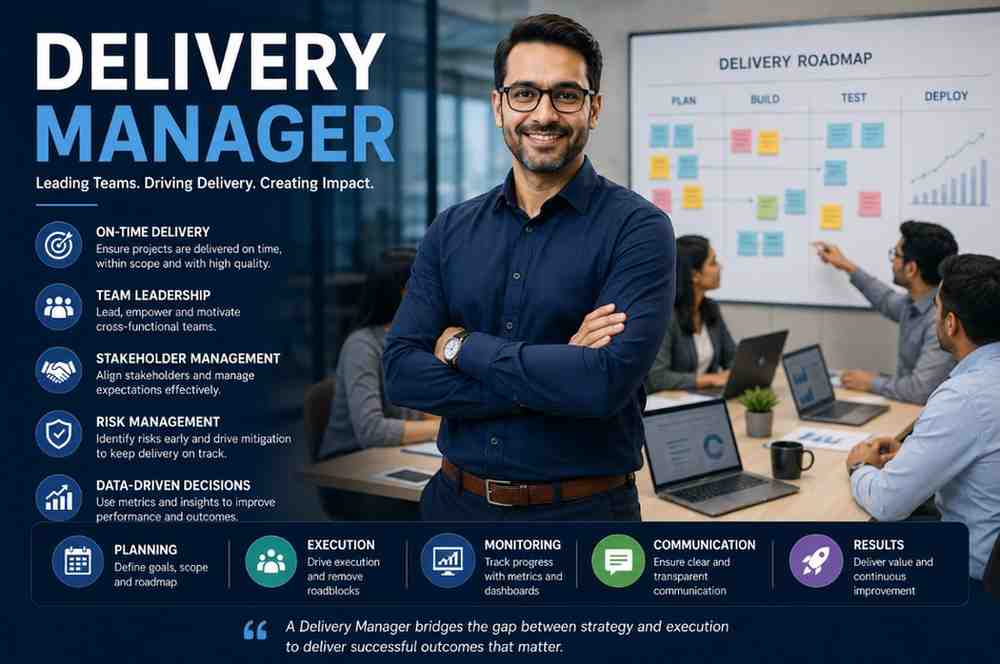
Before you can sell yourself in an interview, you need to deeply understand the role. A Delivery Manager bridges the gap between business strategy and technical execution. Unlike a traditional Project Manager who tracks timelines and budgets, a Delivery Manager owns the end-to-end flow of value — from backlog prioritisation to stakeholder communication to release management.
Core responsibilities include: leading Agile or hybrid delivery teams, managing dependencies across programmes, removing blockers, reporting RAG status upward, and ensuring that delivery outcomes align with business goals. Understanding this distinction will shape how you answer every single question in your interview.
The 30-Day Plan: Four Phases

Structure your preparation into four focused phases. Do not skip or compress phases — each one builds on the last.
Phase 1 · Days 1–7
Foundation & Self-Audit
Map your experience to the delivery manager competency framework. Identify gaps early.
Phase 2 · Days 8–16
Deep Skill Building
Study Agile, ITIL, stakeholder management, metrics, and tooling used at the target company.
Phase 3 · Days 17–24
Story & Answer Prep
Build your STAR-format story bank. Practice out loud. Record and review yourself.
Phase 4 · Days 25–30
Mock Interviews & Refinement
Full mock sessions, sharpen your questions for the panel, and do final company research.

Phase 1 — Days 1–7
Foundation & Self-Audit
Start with an honest skills inventory
Pull out your CV and map every bullet point to a delivery management competency: planning & scheduling, risk management, stakeholder communication, team leadership, Agile coaching, financial reporting, and tooling. For each competency, rate yourself honestly from 1 to 5. The gaps you find now are your revision priority list for Phase 2.
Gururo Tip
On the Gururo platform, many DM candidates skip the self-audit and jump straight into mock interviews. The coaches at Gururo consistently report that candidates who do a structured self-audit in week one perform significantly better in later sessions — because they know exactly which stories to rehearse and which gaps to address.
Research the company deeply
Go beyond the “About Us” page. Look at engineering blogs, LinkedIn posts from the CTO or Head of Engineering, Glassdoor reviews, and any publicly available case studies. You need to understand their delivery culture — are they Agile purists? Do they use SAFe? Are they in a large-scale transformation? Your answers in the interview must mirror their language and context.
- Read the job description three times and extract every keyword
- Map keywords to your experience and note any gaps
- Research the company’s delivery methodology and team structure
- Identify two or three current business challenges they face
- Connect with someone at the company on LinkedIn for an informal conversation
Phase 2 — Days 8–16
Deep Skill Building
Master the frameworks that matter
Delivery Managers are expected to speak fluently about Agile frameworks — Scrum, Kanban, SAFe — and also about governance and reporting structures. Spend days 8–12 revisiting whichever of these is weakest for you. Read the Scrum Guide if you have not recently. Understand how velocity, cycle time, lead time, and throughput differ and when each matters.
Learn to talk about metrics
Interviewers for DM roles will almost always ask about how you measure delivery health. Be prepared to discuss: sprint velocity trends, defect escape rate, deployment frequency, mean time to recovery (MTTR), and customer satisfaction scores. More importantly, be ready to explain what you did when a metric moved in the wrong direction.
Example answer framing
“In my last programme, our cycle time had grown to 18 days. I introduced a weekly flow efficiency review and worked with the team to reduce handoff wait time. Within two sprints, cycle time dropped to 11 days and on-time delivery improved from 62% to 81%.”
Tooling awareness
If you are not confident with Jira, Confluence, Azure DevOps, or whatever tools the company uses — spend at least two days getting hands-on. Create a free Jira account and build a sample project board with epics, stories, and a release roadmap. Being able to reference concrete tooling experience signals readiness without requiring hand-holding.
Stakeholder management — the make-or-break skill
Senior hiring managers care more about stakeholder management than almost anything else. Prepare stories about: managing an escalation from a difficult executive, bringing a sceptical stakeholder around to support a change, and balancing competing priorities from different business units. These stories will be asked in some form in every DM interview.
Phase 3 — Days 17–24
Build Your Story Bank
Use the STAR+ method
STAR (Situation, Task, Action, Result) is the baseline. Add a fifth element — Learning — to show self-awareness and growth mindset. Interviewers at director level are looking for candidates who reflect, not just candidates who performed. Aim to build at least 12 distinct stories, each mappable to a different competency.
Your story bank should cover: a project that went wrong and how you recovered it, a time you delivered under significant constraint, a conflict between team members you resolved, a stakeholder you had to manage through resistance, a time you improved a delivery process, and a complex dependency you navigated across teams.
Gururo Tip
Gururo’s structured interview coaching framework recommends writing each story on a single index card: one card per competency, with the headline outcome at the top in bold. During mock sessions, candidates who use physical story cards show measurably less “blank moment” hesitation than those who try to recall stories from memory alone.
The 15 questions you will almost certainly be asked
1. How do you manage delivery when scope, time, and budget are all under pressure simultaneously?
Focus: prioritisation framework, stakeholder alignment, trade-off communication.
2. Tell me about a delivery that failed. What happened and what did you learn?
Focus: accountability, root cause analysis, systemic improvement
3. How do you measure the health of a delivery programme?
Focus: metrics fluency, leading vs lagging indicators
4. Describe a situation where a key stakeholder was obstructing progress. How did you handle it?
Focus: influence without authority, political navigation
5. How do you build trust with engineering teams who may be sceptical of management involvement?
Focus: servant leadership, technical empathy
6. Walk me through how you would onboard yourself into a programme that is already in trouble.
Focus: discovery approach, rapid diagnosis, early wins
7. How do you manage cross-team dependencies in a large programme?
Focus: dependency mapping, RAID logs, programme-level rituals
8. What is your approach to risk management?
Focus: risk identification, appetite, mitigation vs acceptance
9. How do you report delivery status to senior leadership?
Focus: RAG reporting, narrative over numbers, exception management
10. Describe how you have improved a delivery process in a previous role.
Focus: process improvement, metrics before and after, change management
11. How do you handle a team that is consistently missing sprint commitments?
Focus: root cause analysis, psychological safety, capacity vs commitment
12. What is the difference between a Delivery Manager and a Project Manager?
Focus: value flow, Agile mindset, output vs outcome orientation
13. How do you prioritise your own work when managing multiple workstreams?
Focus: time management, delegation, escalation judgment
14. Tell me about a time you had to influence a decision without formal authority.
Focus: data-driven persuasion, coalition building
15. Why do you want to join this company specifically?
Focus: research depth, alignment of values, genuine motivation
Phase 4 — Days 25–30
Mock Interviews & Final Refinement
Run at least three full mock interviews
Do not just read your stories — speak them out loud to another person. Ask a trusted colleague, mentor, or career coach to role-play as an interviewer. Record yourself on video for at least one session. You will catch filler words, incomplete answers, and stories that ramble without a clear outcome. Each mock session should be followed by a structured debrief.
Gururo Tip
Gururo offers structured delivery manager mock interview sessions with experienced coaches who have hired for DM roles at major tech and consulting firms. Candidates who complete at least two mock sessions with professional feedback report significantly higher confidence scores going into the real interview — and the data shows this translates to offer rates.
Prepare five strong questions to ask the panel
Interviews are two-way. Asking thoughtful questions signals seniority and curiosity. Avoid questions about salary or holidays in first-round interviews. Instead, ask: What does success look like in the first 90 days? What are the biggest delivery challenges the team is navigating right now? How is delivery performance currently measured at programme level? How does the team balance Agile delivery with governance and compliance requirements?
Final day checklist
- Re-read the job description and your top five stories
- Review the company’s recent news, blog posts, or announcements
- Confirm interview format, panellist names, and location or video link
- Prepare your opening 90-second introduction — practice it three times
- Get eight hours of sleep the night before
Common Mistakes That Derail Delivery Manager Interviews
Even well-prepared candidates make avoidable errors. The most common: being too generic in answers (saying “we” instead of “I”), focusing on activities rather than outcomes, failing to quantify the impact of their work, and not demonstrating awareness of the business context behind delivery decisions.
Another frequent mistake is underplaying stakeholder management experience. Hiring managers at director or VP level are hiring someone who will represent delivery to senior leaders. If your answers focus only on the technical or team side, you will come across as underprepared for the political and organisational demands of the role.
Finally, many candidates fail to close the interview well. Before leaving, clearly restate your interest in the role and ask about next steps. It signals conviction and helps the interviewer remember you as a decisive, proactive candidate — which is exactly what a Delivery Manager should be.
Key Concepts to Revise Before Interview Day
- Agile manifesto values and 12 principles — know them, not just the words
- Scrum roles: Product Owner, Scrum Master, Development Team responsibilities
- Kanban flow metrics: cycle time, lead time, throughput, WIP limits
- SAFe basics if the company operates at scale
- RAID logs: Risks, Assumptions, Issues, Dependencies
- OKR vs KPI — when to use which and how they connect to delivery
- Change management basics: ADKAR or Kotter’s 8-step model
- DevOps DORA metrics: deployment frequency, lead time for changes, MTTR, change failure rate
FAQs
How long does it take to prepare for a Delivery Manager interview?
Most candidates can build strong interview readiness within 30 to 45 days with focused preparation.
Are Delivery Manager interviews technical?
Delivery Manager interviews are moderately technical. Candidates are expected to understand software delivery workflows, DevOps concepts, Agile methodologies, and release management processes.
What is the most important skill for Delivery Managers?
Leadership and stakeholder communication are often considered the most important skills for successful Delivery Managers.
Do I need coding skills for a Delivery Manager role?
Most Delivery Manager roles do not require strong coding expertise, but technical understanding is highly valuable.
Which companies hire Delivery Managers frequently?
Companies hiring Delivery Managers include software product companies, SaaS startups, consulting firms, IT services companies, fintech organizations, healthcare tech firms, and enterprise software companies.
What salary can Delivery Managers expect in 2026?
Delivery Manager salaries vary based on location, experience, and company size, but experienced professionals often earn highly competitive compensation packages in the tech industry.
Final Thoughts
Preparing for a Delivery Manager interview in 30 days may seem challenging at first, but with the right strategy, structured learning plan, and consistent practice, it is completely achievable. In today’s competitive tech industry, companies are not simply hiring professionals who can manage timelines or coordinate meetings. They are looking for Delivery Managers who can lead cross-functional teams, solve complex delivery challenges, manage stakeholder expectations, improve Agile execution, and drive measurable business results.
The most successful candidates focus on practical preparation instead of memorizing theoretical concepts. They practice real-world delivery scenarios, strengthen communication and leadership skills, prepare impactful behavioral stories, and learn how to explain project outcomes using metrics and business impact. This is exactly what interviewers expect from modern Delivery Managers in 2026.
A strong Delivery Manager interview preparation plan should include Agile methodologies, stakeholder management, risk handling, sprint execution, delivery metrics, conflict resolution, release management, and technical awareness of modern software development practices. Candidates who combine leadership thinking with delivery execution stand out significantly during interviews.
Consistency is the biggest advantage during preparation. Even spending a few focused hours daily on mock interviews, Agile scenarios, leadership questions, and delivery management concepts can dramatically improve confidence and interview performance within a month.
If you follow this 30-day Delivery Manager interview roadmap seriously, you will not only improve your chances of clearing interviews but also develop the leadership mindset required to succeed in high-growth software companies, SaaS organizations, IT services firms, and enterprise technology teams.
The goal is not just to crack the interview — the goal is to become the kind of Delivery Manager companies actively want to hire.
Fact-checked against PMI’s current CCR rules · Last updated 24 Oct 2026
Live 1:1 executive preparation
Program Manager Interview Preparation
- Realistic hiring-style interview
- Structured competency scorecard
- Personal improvement roadmap
- Coaches who have led real programs
Prepare with an expert
Questions about your exam prep?
Chat with our team. Start chat →
Keep preparing with these guides
More interview guides like this one.

Interview Prep
Interview Prep
Interview Prep
Prepare with an expert
Live 1:1 coaching for project, program and leadership interviews.
Live 1:1 executive preparation with a scorecard. From $149.
Subscribe To Our Weekly Newsletter
No spam, notifications only about new products, updates.
Program Manager Interview Prep
Live 1:1 · from $149