
Interview Prep
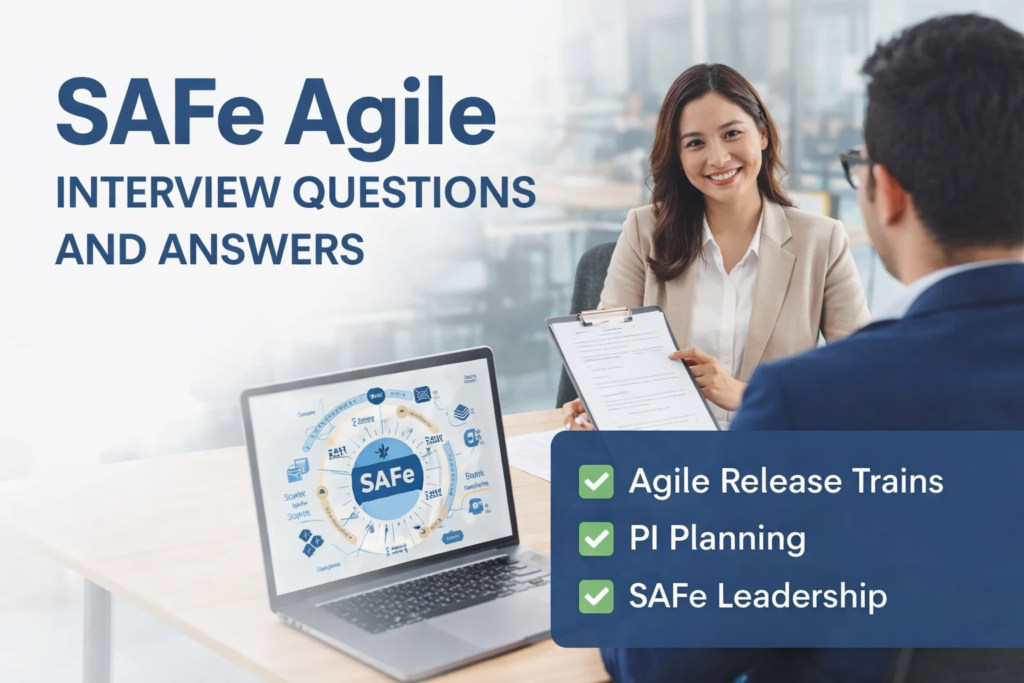
SAFe Agile Interview Questions and Answers
Sudeep Dwivedi
Updated 24 Oct 2026
8 min read
✓ 1:1 interview coaching available
On this page
The Scaled Agile Framework (SAFe) is widely used by large enterprises to implement Agile practices across multiple teams, programs, and departments. While Agile methodologies such as Scrum work well for small teams, organizations often require a structured framework to coordinate dozens or even hundreds of teams working on complex products.
SAFe provides a structured approach for scaling Agile practices while maintaining alignment with business goals. Because of its widespread adoption in enterprises, interviewers often test candidates on their knowledge of:
Preparing for an enterprise Agile role? Our project manager interview preparation course includes a mock interview with feedback.
- Agile Release Trains (ART)
- Program Increment (PI) Planning
- Lean-Agile leadership
- coordination across multiple Agile teams
- enterprise-level Agile transformation
Candidates applying for roles such as Agile Program Manager, SAFe Scrum Master, Release Train Engineer, or Agile Coach are frequently asked SAFe-related interview questions.
This guide covers the most common SAFe Agile interview questions and answers, including key concepts related to Agile Release Trains, PI planning, and SAFe leadership.
Before reviewing these questions, you may also want to explore the full interview preparation guide:
project-manager-interview-preparation-guide
What Is SAFe Agile?

The Scaled Agile Framework (SAFe) is a framework designed to help large organizations adopt Agile practices across multiple teams and programs.
While traditional Agile frameworks such as Scrum focus on small teams, SAFe enables organizations to coordinate dozens or hundreds of Agile teams working toward shared business goals.
Key components of SAFe include:
- Agile Release Train (ART) – a group of Agile teams working together
- Program Increment (PI) – a planning cycle for delivering value[
- Lean-Agile leadership – leadership that supports Agile transformation
- continuous delivery pipeline – automated delivery of features and improvements
SAFe provides structure for organizations implementing Agile at scale while maintaining flexibility and collaboration.
For broader Agile interview questions, see:
Agile-interview-questions
Why Companies Use SAFe
Organizations adopt SAFe because it helps:
✅ Align business and technology teams
✅ Improve cross-team collaboration
✅ Accelerate product delivery
✅ Increase transparency
✅ Enhance quality and predictability
✅ Support large-scale Agile transformations
Why Employers Ask SAFe Agile Interview Questions
Employers ask SAFe interview questions to evaluate whether candidates can manage Agile initiatives in large organizations.
Interviewers typically assess several competencies.
Enterprise Agile Experience
Organizations want candidates who understand Agile transformation at scale.
Coordination Across Teams
Large enterprises often have multiple Agile teams working simultaneously.
Knowledge of SAFe Roles
Candidates should understand roles such as Release Train Engineer, Product Management, and System Architect.
Leadership in Agile Environments
Leaders must guide teams through Agile adoption and transformation.
Example interview question:
What is the role of the Release Train Engineer in SAFe?
For additional leadership interview questions, see:
leadership-interview-questions
Common SAFe Agile Interview Questions and Answers
Below are some of the most frequently asked SAFe Agile interview questions.
Common SAFe Agile interview questions include:
- What is the Scaled Agile Framework?
- What is an Agile Release Train?
- What is Program Increment (PI) planning?
- What are the key roles in SAFe?
- What is the purpose of a Program Increment?
Preparing structured answers for these questions helps candidates demonstrate enterprise Agile expertise.
Common SAFe Interview Mistakes
1. Confusing Scrum With SAFe
SAFe extends Agile practices beyond a single team and focuses on enterprise alignment.
2. Ignoring Business Outcomes
Always connect Agile practices to business value.
3. Lack of Practical Examples
Interviewers want real-world implementation experience.
4. Weak Understanding of PI Planning
PI Planning is central to SAFe and frequently discussed.
5. Not Understanding Dependencies
Cross-team coordination is one of SAFe’s core challenges.
What Is the Scaled Agile Framework (SAFe)?
Why interviewers ask this question
Interviewers want to confirm that candidates understand the fundamentals of SAFe.
Best way to answer
Explain how SAFe enables Agile practices across large organizations.
Example answer
The Scaled Agile Framework (SAFe) is a framework that helps organizations implement Agile practices at scale. It provides structure for coordinating multiple Agile teams, aligning development with business goals, and delivering value continuously.
SAFe integrates Agile principles with Lean thinking to support enterprise-level Agile transformation.
What Is an Agile Release Train (ART)?
Why interviewers ask this question
ART is one of the core concepts of the SAFe framework.
Best way to answer
Explain how Agile teams collaborate within an ART.
Example answer
An Agile Release Train (ART) is a long-lived team of Agile teams that work together to deliver value continuously. The ART aligns multiple teams around shared objectives and coordinates development across teams.
ART typically consists of 50 to 125 people working across several Agile teams.
What Is PI Planning?

Why interviewers ask this question
PI planning is a key event in the SAFe framework.
Best way to answer
Explain how PI planning aligns teams with program goals.
Example answer
Program Increment (PI) planning is a collaborative event where Agile teams plan the work they will complete during the next program increment.
During PI planning, teams align on objectives, identify dependencies, and create a shared roadmap for delivering features.
What Are the Roles in SAFe?
Why interviewers ask this question
SAFe defines several roles responsible for coordinating Agile teams.
Key SAFe roles
Release Train Engineer (RTE)
Facilitates the Agile Release Train and ensures coordination across teams.
Product Management
Defines program priorities and ensures alignment with customer needs.
System Architect
Provides technical guidance and architecture decisions.
Scrum Master
Facilitates Agile ceremonies and supports the team.
For Scrum-specific interview questions, see:
scrum-master-interview-questions
What Is the Role of the Release Train Engineer?
Why interviewers ask this question
The Release Train Engineer plays a leadership role within the SAFe framework.
Best way to answer
Explain the coordination and facilitation responsibilities of the RTE.
Example answer
The Release Train Engineer (RTE) acts as the chief facilitator of the Agile Release Train. The RTE coordinates Agile teams, manages dependencies, and ensures alignment across the program.
The RTE also facilitates PI planning events and helps resolve issues that affect multiple teams.
For additional leadership interview questions, see:
leadership-interview-questions
Agile Release Train Interview Questions
Interviewers may ask questions specifically about Agile Release Trains.
Examples include:
- What is the purpose of an Agile Release Train?
- How do teams collaborate within an ART?
- What is the role of system demos in an ART?
Strong answers should highlight collaboration, alignment, and continuous delivery.
For additional Agile project manager questions, see:
Agile-project-manager-interview-questions
PI Planning Interview Questions
PI planning is a central event in SAFe implementations.
Examples of PI planning questions include:
- What happens during PI planning?
- What are the outcomes of PI planning?
- How do teams align objectives during PI planning?
Candidates should demonstrate understanding of team alignment and program coordination.
For additional scenario-based questions, see:
scenario-based-interview-questions-project-manager
SAFe Leadership Interview Questions
SAFe implementations often require strong leadership and coordination.
Examples of SAFe leadership questions include:
- How do leaders support Agile transformations?
- How do you coordinate multiple Agile teams?
- How do you manage dependencies between teams?
Effective answers should demonstrate leadership and strategic thinking.
For conflict management examples, see:
conflict-resolution-interview-questions
Final Preparation Checklist
Before your SAFe interview, ensure you can confidently explain:
✅ SAFe principles and core values
✅ Agile Release Trains (ARTs)
✅ PI Planning
✅ Release Train Engineer responsibilities
✅ Product Manager vs Product Owner
✅ ROAM risk management
✅ Lean Portfolio Management
✅ DevOps and Continuous Delivery
✅ Business Agility concepts
✅ Real-world Agile transformation examples
Tips to Prepare for SAFe Agile Interviews

Preparing for SAFe interviews requires understanding both Agile principles and enterprise-level coordination.
1. Understand SAFe Framework Structure
Candidates should review SAFe concepts such as Agile Release Trains and Program Increments.
2. Learn SAFe Roles and Responsibilities
Understanding roles such as RTE, Product Management, and System Architect is essential.
3. Study Agile Release Train Concepts
Candidates should understand how teams collaborate within an ART.
4. Practice Scenario-Based Agile Questions
Interviewers may present real-world scenarios related to Agile transformations.
5. Demonstrate Leadership in Scaled Agile Environments
Candidates should explain how they coordinate multiple Agile teams.
For additional preparation strategies, see:
agile-interview-questions
&
project-manager-interview-preparation-guide
Practice SAFe Agile Interview Questions With a Mock Interview
SAFe-related questions frequently appear in enterprise Agile roles such as Agile Program Manager or Release Train Engineer.
Many candidates struggle because they cannot clearly explain how SAFe concepts apply to real programs.
Mock interviews help candidates:
- practice answering SAFe interview questions
- receive expert feedback
- improve confidence when discussing enterprise Agile frameworks
- simulate real interview scenarios
Prepare for SAFe Agile interviews with a Project Manager Mock Interview before your real interview.
Learn more here:
Project Manager Mock Interview
Frequently Asked Questions
What are SAFe Agile interview questions?
SAFe Agile interview questions test candidates on concepts related to scaling Agile across large organizations, including Agile Release Trains and PI planning.
What is the Scaled Agile Framework?
The Scaled Agile Framework (SAFe) is a framework that helps organizations implement Agile practices across multiple teams and programs.
What is the role of an Agile Release Train?
An Agile Release Train coordinates multiple Agile teams working together to deliver value continuously.
How do you prepare for SAFe Agile interviews?
Candidates should review SAFe concepts, understand Agile Release Trains and PI planning, and practice scenario-based questions.
Is SAFe certification enough to clear interviews?
No. Certification helps demonstrate knowledge, but interviewers typically evaluate practical implementation experience and problem-solving capabilities.
Which SAFe role is most commonly discussed in interviews?
Release Train Engineer, Product Manager, Product Owner, Scrum Master, and Lean-Agile Leadership responsibilities are frequently discussed.
What is the most important SAFe event?
PI Planning is widely considered the most important event because it aligns teams, stakeholders, objectives, and dependencies.
Are scenario-based questions common in SAFe interviews?
PI Planning is widely considered the most important event because it aligns teams, stakeholders, objectives, and dependencies.
Conclusion
SAFe interviews are designed to assess more than framework knowledge—they evaluate your ability to apply Agile principles at enterprise scale, align multiple teams around shared objectives, and deliver measurable business outcomes. Employers want professionals who can navigate complexity, manage dependencies, facilitate collaboration, and drive continuous improvement across large organizations.
The strongest candidates combine a solid understanding of SAFe concepts with real-world examples that demonstrate leadership, execution excellence, stakeholder management, and business impact. Focus on mastering PI Planning, Agile Release Trains, Lean-Agile Leadership, and DevOps practices while preparing STAR-based stories that showcase your experience.
With structured preparation, practical examples, and a clear understanding of how SAFe enables Business Agility, you can confidently approach your interview and position yourself as a valuable contributor to any large-scale Agile transformation initiative.
Fact-checked against PMI’s current CCR rules · Last updated 24 Oct 2026
1:1 coaching · from $59
Project Manager Interview Preparation
- Real PM interview questions and model answers
- 1:1 coaching with an experienced PM
- Mock interview with feedback
- Resume and LinkedIn review
Prepare with an expert
Questions about your exam prep?
Chat with our team. Start chat →
Keep preparing with these guides
More interview guides like this one.
Interview Prep
Interview Prep
Interview Prep
Prepare with an expert
Live 1:1 coaching for project, program and leadership interviews.
Live 1:1 executive preparation with a scorecard. From $149.
Subscribe To Our Weekly Newsletter
No spam, notifications only about new products, updates.
PM Interview Prep
1:1 coaching · from $59