
Interview Prep
Stakeholder Management Interview Questions (With Example Answers)
Sudeep Dwivedi
Updated 24 Oct 2026
8 min read
✓ 1:1 interview coaching available
On this page
Stakeholder management is one of the most critical responsibilities of a project manager. Projects rarely succeed without effective communication, alignment, and collaboration between stakeholders.
Because of this, interviewers frequently ask stakeholder management interview questions to evaluate how candidates communicate with stakeholders, manage expectations, and resolve conflicts.
Stakeholders may include:
- clients and customers
- senior executives
- project sponsors
- cross-functional teams
- external vendors
A successful project manager must balance competing priorities while ensuring stakeholders remain aligned with project goals.
This guide covers the most common stakeholder management interview questions, including example answers and strategies for handling complex stakeholder situations.
As a result, stakeholder management interview questions are commonly asked during management and leadership interviews. Employers want to assess your ability to build relationships, manage expectations, resolve conflicts, influence decisions, and maintain stakeholder satisfaction.
Before reviewing these questions, you may also want to explore the complete preparation guide: project manager interview preparation guide
To practise these answers with feedback from an expert, try 1:1 project manager interview coaching.
What Is Stakeholder Management?
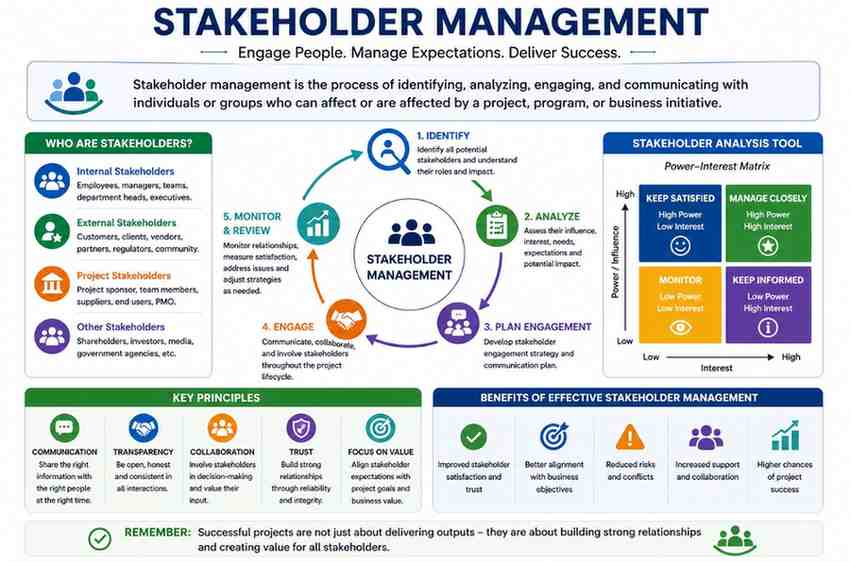
Stakeholder management is the process of identifying, analyzing, engaging, and communicating with individuals or groups who can influence or are affected by a project, program, or business initiative.
Stakeholders may include:
- Clients and customers
- Senior executives
- Project sponsors
- Team members
- Vendors and suppliers
- Regulatory authorities
- Business users
- External partners
Effective stakeholder management helps ensure project alignment, reduces resistance, improves communication, and increases the likelihood of project success.

Why Do Employers Ask Stakeholder Management Questions?
Recruiters use these questions to evaluate your ability to:
✔ Build strong relationships
✔ Manage expectations
✔ Influence decision-making
✔ Resolve conflicts
✔ Communicate effectively
✔ Handle difficult stakeholders
✔ Navigate organizational politics
✔ Deliver successful outcomes
What Effective Stakeholder Management Looks Like
Stakeholder management refers to the process of identifying, communicating with, and aligning stakeholders throughout the project lifecycle.
Stakeholders influence project success in different ways. Some stakeholders provide strategic direction, while others may impact resources, timelines, or decision making.
Effective stakeholder management includes:
- identifying key stakeholders
- understanding stakeholder expectations
- maintaining clear communication
- managing stakeholder conflicts
- aligning stakeholders with project objective
Strong stakeholder communication ensures that project goals remain clear and that potential issues are addressed early.
For more project management interview questions, see: project manager interview questions
Why Stakeholder Questions Are Asked in Project Manager Interviews
Interviewers ask stakeholder management questions to evaluate whether candidates can handle complex relationships and communication challenges.
These questions help employers assess several competencies.
Communication Skills
Project managers must clearly communicate project goals, timelines, and risks.
Negotiation Skills
Stakeholders often have competing priorities that require negotiation.
Conflict Resolution
Disagreements between stakeholders can impact project progress.
Leadership and Influence
Project managers often need to influence stakeholders without direct authority.
To review additional leadership questions, visit: leadership interview questions
Common Stakeholder Management Interview Questions
Below are some of the most frequently asked stakeholder management interview questions.
Common questions include:
- How do you identify project stakeholders?
- How do you manage stakeholders with conflicting priorities?
- How do you communicate project progress to stakeholders?
- How do you handle difficult stakeholders?
- How do you manage stakeholder expectations?
Preparing structured answers for these questions helps demonstrate strong leadership and communication skills.
How Do You Manage Stakeholders With Conflicting Priorities?
Why interviewers ask this question
Stakeholder conflicts are common in complex projects.
Best way to answer
Demonstrate how you facilitate discussions and align priorities.
Example answer
When stakeholders have conflicting priorities, I first ensure that all perspectives are understood. I facilitate discussions that focus on the project objectives and business value.
By reviewing project constraints such as timeline and budget, I help stakeholders reach a consensus that supports the overall project goals.
How Do You Communicate Project Progress to Stakeholders?
Why interviewers ask this question
Communication is essential for maintaining stakeholder alignment.
Best way to answer
Explain how you maintain transparency.
Example answer
I communicate project progress through regular status reports, stakeholder meetings, and dashboards that highlight key metrics.
These updates ensure stakeholders understand project progress, potential risks, and upcoming milestones.
How Do You Handle Difficult Stakeholders?
Why interviewers ask this question
Some stakeholders may challenge project decisions or request frequent changes.
Best way to answer
Focus on communication, empathy, and negotiation.
Example answer
When dealing with difficult stakeholders, I focus on understanding their concerns and expectations. I maintain open communication and ensure that their feedback is acknowledged.
At the same time, I clearly explain project constraints and align discussions with the overall project objectives.
Stakeholder Conflict Scenario Questions
Interviewers may also ask situational questions related to stakeholder conflicts.
Examples include:
- What would you do if stakeholders disagree on project priorities?
- How would you handle a client requesting unrealistic changes?
- What would you do if stakeholders refuse to approve project deliverables?
Strong answers should highlight:
- negotiation skills
- clear communication
- problem-solving approach
For more scenario questions, see: scenario based interview questions project manager
Stakeholder Communication Questions
Project managers must ensure stakeholders remain informed throughout the project lifecycle.
Examples of stakeholder communication questions include:
- How do you communicate project risks to stakeholders?
- How do you ensure stakeholders understand project goals?
- How do you handle communication between technical teams and business stakeholders?
Candidates should demonstrate structured communication strategies.
Show Strong Communication Skills
Across every answer, weave in evidence of the five habits interviewers are quietly listening for:
Active Listening
Understanding stakeholder concerns helps build trust. Restating a stakeholder’s concern in your own words before responding shows you’ve actually absorbed it, not just waited for your turn to talk.
Negotiation skills
Finding compromises that align with project goals helps maintain stakeholder relationships. Trading something of lower value for something of higher value, rather than simply asking stakeholders to compromise and hoping they agree.
Conflict resolution
Separating the position someone is arguing for from the underlying interest behind it, which is usually where the real common ground lives.
Executive communication
Leading with the headline and the ask, then offering detail only if it’s requested, rather than building up to the point. Regular updates prevent misunderstandings.
Relationship building
Investing in trust before you need it, so the first real conversation with a stakeholder isn’t the day something goes wrong.
None of these need a dedicated story of their own. The strongest interview answers usually reference two or three of them inside a single example — for instance, describing how you listened to a sponsor’s concern, separated their stated objection from what they actually cared about, and then negotiated a revised timeline that addressed it.
How to Manage Difficult Stakeholders
Managing difficult stakeholders requires strong emotional intelligence and leadership.
Strategies include:
Active Listening
Understanding stakeholder concerns helps build trust.
Clear Expectations
Defining project constraints ensures stakeholders understand limitations.
Structured Communication
Regular updates prevent misunderstandings.
Negotiation
Finding compromises that align with project goals helps maintain stakeholder relationships.
Tips for Answering Stakeholder Management Questions
Here are several strategies for answering stakeholder management interview questions effectively.
1. Demonstrate Communication Skills
Explain how you communicate clearly with different stakeholders.
2. Show Leadership and Influence
Project managers often influence stakeholders without direct authority.
3. Use Real Examples
Provide examples from previous projects.
4. Highlight Conflict Resolution
Stakeholder conflicts are common in projects.
5. Emphasize Collaboration
Successful project managers encourage collaboration between stakeholders.
For more preparation tips, see: project manager interview tips
Practice Stakeholder Questions With a Mock Interview
Stakeholder management questions show up in almost every project manager interview, and many candidates struggle with them for the same reason: these questions need both a clear story and confident, structured delivery — and that combination is genuinely hard to build by reading alone.
Mock interviews help candidates:
- practice stakeholder communication scenarios
- improve structured responses
- receive expert feedback
- gain confidence before real interviews
A mock interview closes that gap. Practicing out loud, under light pressure, with someone pushing back on vague parts of your answer, does more for your delivery in an hour than another week of silent preparation. It surfaces the moments where your STAR structure quietly breaks down, where you reach for jargon instead of a concrete example, or where a story that sounded complete in your head turns out to be missing the result.
Practice with a Project Manager Mock Interview before your real interview.
Learn more here: project manager mock interview
How to Structure Your Answers

Use the STAR Method
S
Situation
T
Task
A
Action
R
Result
Situation
Explain the challenge you walked into.
Task
Describe your specific responsibility in it.
Action
Result
Demonstrate Business Awareness
Employers value candidates who understand:
- Business objectives
- Organizational priorities
- Stakeholder influence
- Strategic decision-making
Always connect stakeholder management activities to business outcomes.
Show Strong Communication Skills
Your answers should demonstrate:
- Active listening
- Negotiation skills
- Conflict resolution
- Executive communication
- Relationship building
Common Mistakes to Avoid
❌ Treating all stakeholders the same
❌ Ignoring difficult stakeholders
❌ Failing to communicate risks
❌ Overpromising outcomes
❌ Avoiding conflict discussions
❌ Providing vague examples
Conclusion
It’s not about keeping people informed
Stakeholder management is a critical skill that separates average project managers from exceptional leaders. Whether you’re a Project Manager, Program Manager, Delivery Manager, Product Manager, or PMO professional, your ability to engage stakeholders, manage expectations, resolve conflicts, and build strong relationships can significantly influence project success.
Employers actively seek professionals who can communicate effectively with executives, clients, team members, and business stakeholders while maintaining alignment with organizational goals. That’s why stakeholder management interview questions are a common and important part of management-level interviews.
By preparing thoughtful answers, using the STAR method, and supporting your responses with real-world examples, you can confidently demonstrate your leadership, communication, negotiation, and relationship-management capabilities during interviews.
Remember, successful stakeholder management is not just about keeping people informed—it’s about building trust, creating alignment, influencing decisions, and delivering measurable business value. Mastering these skills will not only help you succeed in interviews but also accelerate your career growth and establish you as a trusted leader within your organization.
Frequently Asked Questions (FAQs)
What is stakeholder management in project management?
Stakeholder management involves identifying, communicating with, and aligning stakeholders throughout the project lifecycle.
Why are stakeholder questions asked in interviews?
These questions help employers evaluate communication skills, conflict resolution ability, and leadership.
How do you handle conflicting stakeholders?
Project managers should facilitate discussions, clarify priorities, and align stakeholders with project objectives.
What are examples of stakeholder interview questions?
Examples include questions about managing difficult stakeholders, resolving stakeholder conflicts, and communicating project progress.
What are stakeholder management interview questions?
These are interview questions designed to assess a candidate’s ability to identify, engage, influence, and manage stakeholders throughout projects or business initiatives.
What skills are essential for effective stakeholder management?
Communication, negotiation, conflict resolution, active listening, influence, emotional intelligence, and relationship management are critical skills.
Fact-checked against PMI’s current CCR rules · Last updated 24 Oct 2026
1:1 coaching · from $59
Project Manager Interview Preparation
- Real PM interview questions and model answers
- 1:1 coaching with an experienced PM
- Mock interview with feedback
- Resume and LinkedIn review
Prepare with an expert
Questions about your exam prep?
Chat with our team. Start chat →
Keep preparing with these guides
More interview guides like this one.
Interview Prep

Interview Prep

Interview Prep
Prepare with an expert
Live 1:1 coaching for project, program and leadership interviews.
Live 1:1 executive preparation with a scorecard. From $149.
Subscribe To Our Weekly Newsletter
No spam, notifications only about new products, updates.
PM Interview Prep
1:1 coaching · from $59