Preparing for a project manager interview is not about memorizing answers — it is about structuring your experience, improving communication, and demonstrating leadership.
Most candidates make the mistake of preparing randomly:
- reading questions without practice
- focusing only on theory
- not preparing real examples
As a result, they struggle to clearly explain their experience during interviews.
This 7-day project manager interview preparation plan gives you a structured roadmap to prepare efficiently, even if you are short on time.
By following this plan, you will:
- prepare strong answers
- improve communication
- practice real interview scenarios
- build confidence before your interview

For the complete picture — from core concepts to advanced scenarios — see Gururo’s Project Manager Interview Preparation.
Why most PM interview prep fails
The single biggest mistake candidates make is treating project manager interview preparation as a reading exercise. They read articles, watch YouTube videos, and feel prepared — but freeze when asked “Tell me about a time you managed a difficult stakeholder.” Reading about STAR answers is not the same as practicing them out loud. This plan fixes that by making every day action-oriented.
How This 7-Day Plan Works
This plan is designed based on how organizations evaluate project managers:
- leadership
- stakeholder management
- problem-solving
- execution capability
Each day focuses on one key area, ensuring complete preparation.

Day 1 – Understand Interview Expectations
Understand the role and the company
Before you prepare a single answer, understand exactly what the company is hiring for. Generic PM prep leads to generic answers. Specific research leads to offers.
- Read the job description three times. Underline every skill and responsibility mentioned.
- Research the company’s products, recent news, and strategic priorities for the past 12 months.
- Identify which type of PM they need: technical, growth, platform, or operational.
- Find 2–3 employees on LinkedIn to understand team culture and expectations.
Before preparing answers, you must understand what companies are evaluating.
🔹 What Organizations Look For
Companies hiring project managers want:
- leaders who can drive teams
- decision-makers under pressure
- strong communicators
- professionals who deliver results
🔹 What You Should Do
- review common interview questions
- understand interview formats
- identify your strengths and gaps
🔹 Example
If a company is product-based, expect:
- Agile questions
- stakeholder scenarios
- delivery-focused discussions
Interviewers probe for technical depth and leadership. See the ones that come up most in Gururo’s Project Manager Interview Questions.
Day 2 – Prepare Your Project Stories
Master the STAR method with your own stories
Behavioral questions are the backbone of every project manager interview. The STAR method (Situation, Task, Action, Result) is the proven framework for answering them well. Today you build your personal story bank.
- Write out 8–10 key stories from your career covering: leadership, conflict, failure, success, prioritization, and ambiguity.
- For each story, ensure the Result includes a specific metric (%, days saved, revenue impact).
- Record yourself answering two stories out loud. Time them to 90–120 seconds.
This is the most important step.
🔹 What You Should Do
Prepare 5–7 real project examples covering:
- project success
- project failure
- stakeholder conflict
- project delay
- leadership challenge
🔹 Example Story
“A project was delayed due to dependency issues. I identified bottlenecks, reallocated resources, and communicated with stakeholders to recover timelines.”
🔹Why This Matters
Organizations want real-world proof of experience, not theoretical answers.
Structure your answers — STAR Method for Project Manager Interviews.
Day 3 – Master Behavioral Questions
Crack product sense and case questions
Product sense questions separate good candidates from great ones. Interviewers want to see how you think, not just what you know. The key is to structure your thinking before you start answering.
- Learn the 4-step product case framework: Clarify → User segments → Pain points → Prioritized solutions.
- Practice on 2–3 real products you use daily (not just the company you are interviewing at).
- Always state your assumptions out loud before solving.
Behavioral questions are asked in almost every interview.
🔹 Common Questions
- Tell me about a time you handled conflict
- Describe a difficult stakeholder
Tell me about a project failure
🔹 What You Should Do
- convert your stories into structured answers
- practice speaking clearly
- focus on outcomes
🔹 Example
Instead of:
“I handled a difficult stakeholder”
Say:
“I aligned a difficult stakeholder by conducting impact analysis and negotiating phased delivery, ensuring project timelines were maintained.
Practice the behavioral side — Behavioral Interview Questions for Project Managers.
Day 4 – Practice Scenario-Based Questions
Sharpen prioritization and trade-off reasoning
Prioritization is what project managers do every single day. Interviewers test it directly. They are not looking for the “right” answer — they are looking for structured, defensible reasoning.
- Study two prioritization frameworks: RICE (Reach, Impact, Confidence, Effort) and ICE scoring.
- Practice explaining a real prioritization decision you made — including what you de-prioritized and why.
- Prepare for the “what would you cut?” version of the question — it shows resource management maturity.
Scenario questions test decision-making.
🔹 Common Scenarios
- project delays
- stakeholder conflicts
- team performance issues
🔹 What You Should Do
- think step-by-step
- explain your approach clearly
- focus on communication
🔹 Example
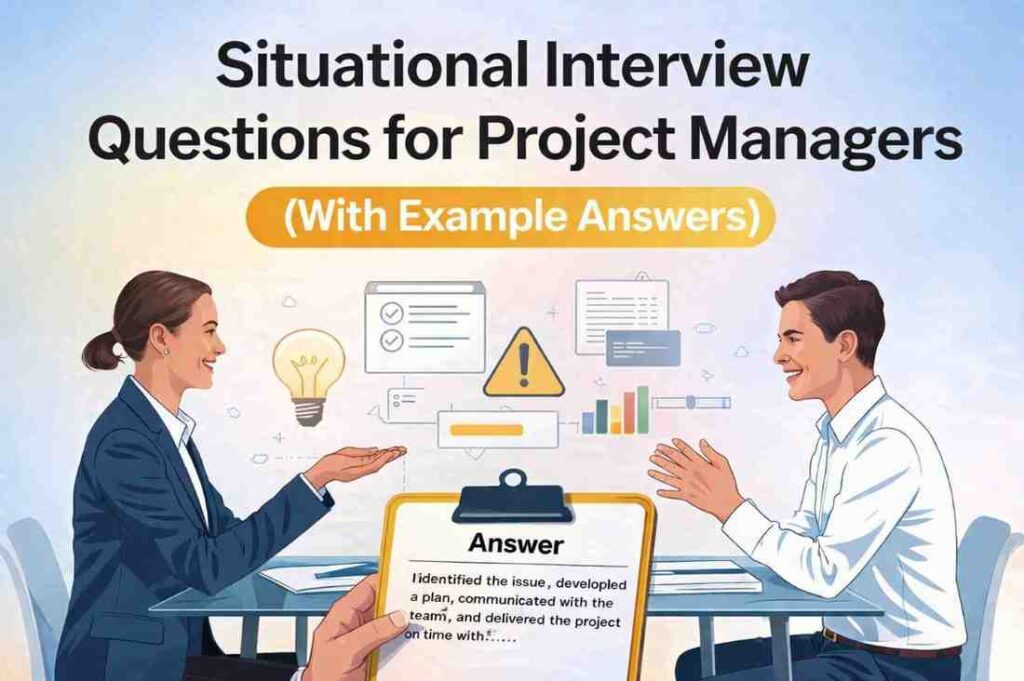
“What would you do if a project is delayed?”
Answer:
“I would identify root cause, assess impact, reprioritize tasks, and communicate with stakeholders.”
If these sharpened your thinking, the full library goes further. See Scenario-Based Interview Questions for Project Managers.
Day 5 – Revise Agile and Core Concepts
Practice metrics, data, and analytical thinking
Modern PMs are expected to be comfortable with data. You do not need to be a data scientist, but you do need to define success clearly, pick the right metrics, and interpret results confidently.
- Learn to distinguish input metrics (things you control) from output metrics (things you want to move).
- For every project in your story bank, define the North Star metric and 2 supporting metrics.
- Practice the “metrics drop” question — what would you investigate if DAU dropped 20% overnight?
Most interviews include Agile questions.
Many companies follow Agile practices. According to the Project Management Institute (PMI), Agile helps teams deliver projects faster with better collaboration.
🔹 Topics to Cover
- Agile methodology
- Scrum framework
- sprint planning
- backlog management
🔹 Example
“What is the role of a PM in Agile?”
Answer:
“To facilitate collaboration, remove blockers, and ensure alignment with stakeholders.”
Cover the Agile side — Agile Interview Questions.
Day 6 – Mock Interview Practice (Game Changer)
Do mock interviews and get real feedback
Reading and practicing alone is not enough. You need someone to push back, ask follow-up questions, and evaluate your clarity. Mock interviews are the single highest-leverage activity in the final stretch of your project manager interview preparation.
- Do a full 45-minute mock interview with a peer, mentor, or using an interview prep platform.
- Record the session. Review it for filler words, vague answers, and moments you lost structure.
- Practice your two weakest question types again immediately after the review.
- Prepare your 3 closing questions — make them specific to the company and role.
This is where most candidates improve dramatically.
🔹 What You Should Do
- simulate real interview
- answer questions under pressure
- get feedback
🔹 Real Impact
Candidates who practice mock interviews:
- improve clarity
- gain confidence
- reduce mistakes
🔹 Example
A candidate with strong experience failed interviews due to poor communication. After mock interviews, they improved answer structure and got selected.
Don’t wait for the real interview to find your gaps. Book a Project Manager Mock Interview.
Day 7 – Final Revision and Confidence Building
Review, rest, and final mental preparation
The night before is not the time to cram new material. It is the time to consolidate what you already know and arrive calm, sharp, and ready. Over-preparing at this stage causes anxiety, not confidence.
- Review your story bank one final time — just read it, do not rewrite it.
- Confirm logistics: interview time, format (video or in-person), interviewer names if known.
- Sleep 7–8 hours. Cognitive performance on sleep deprivation is measurably lower.
- On the day: arrive early, slow your breathing, and remember — they want to hire you.
This is your final preparation day.
🔹 What You Should Do
- revise key answers
- review project stories
- practice speaking
- prepare questions for interviewer
🔹 Example Questions to Ask
- What are the biggest challenges in this role?
- How is success measured for this position?
🔹Final Tip
Focus on:
👉 clarity + confidence + structure
Common Mistakes in Project Manager Interview Preparation Plan
- Preparing without structure
- memorizing answers
- ignoring real examples
- not practicing speaking
skipping mock interviews

How This Plan Aligns With Organization Expectations
This plan ensures you are ready for:
- behavioral interviews
- scenario discussions
- leadership evaluation
- Agile questions
👉 exactly what companies test.
Download This 7-Day Plan (Lead Magnet Opportunity)
You can convert this into a PDF checklist.
👉 “Download 7-Day Interview Preparation Plan PDF”
(ideal for lead capture)
Practice Before Your Real Interview
Preparation without practice is incomplete.
Mock interviews help you:
- test your readiness
- identify weak areas
improve performance
For the complete picture — from core concepts to advanced scenarios — see Project Manager Interview Preparation.
Frequently Asked Questions
Is 7 days enough to prepare for a project manager interview?
Yes, with a structured plan, 7 days is sufficient for focused preparation.
What should I focus on most?
Behavioral questions, real project examples, and scenario-based answers.
Are mock interviews necessary?
Yes, they significantly improve performance.
How do I improve confidence?
Practice structured answers and simulate real interviews.
How long does project manager interview preparation realistically take?
What is the most important thing to prepare for a PM interview?
Should I memorize answers to common PM interview questions?
What resources should I use alongside this plan?
Conclusion
Preparing for a Project Manager interview does not have to be overwhelming. The difference between candidates who consistently receive offers and those who struggle through multiple interview rounds often comes down to preparation, structure, and confidence.
This 7-Day Project Manager Interview Preparation Plan is designed to help you focus on the areas that matter most—from understanding the role and refining your project stories to mastering stakeholder management, leadership examples, behavioral questions, and business impact discussions. By dedicating just one week to structured preparation, you can significantly improve your ability to communicate your experience clearly and demonstrate the skills that hiring managers value most.
Remember, organizations are not simply hiring someone to manage tasks and timelines. They are looking for Project Managers who can lead teams, influence stakeholders, solve complex problems, manage risks, and deliver measurable business results. Your interview is your opportunity to prove that you can do all of those things.
As you work through this preparation plan, focus on building strong STAR-based stories, quantifying your achievements, and connecting your project experience to business outcomes. The more effectively you communicate your impact, the more memorable and compelling your interview responses will become.
By the end of these seven days, you won’t just be better prepared—you’ll be better positioned to stand out from other candidates competing for the same role.
Invest one focused week in your preparation today, and you could open the door to your next Project Manager opportunity tomorrow.
Success in Project Manager interviews is rarely about having the most experience. It’s about presenting your experience with clarity, confidence, and measurable impact.