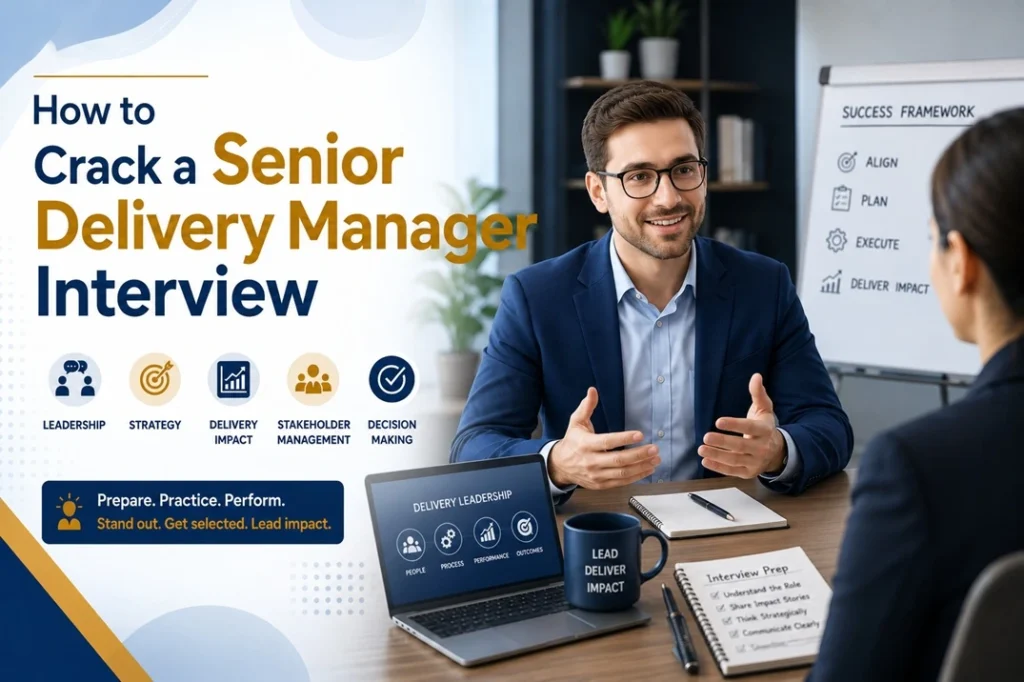
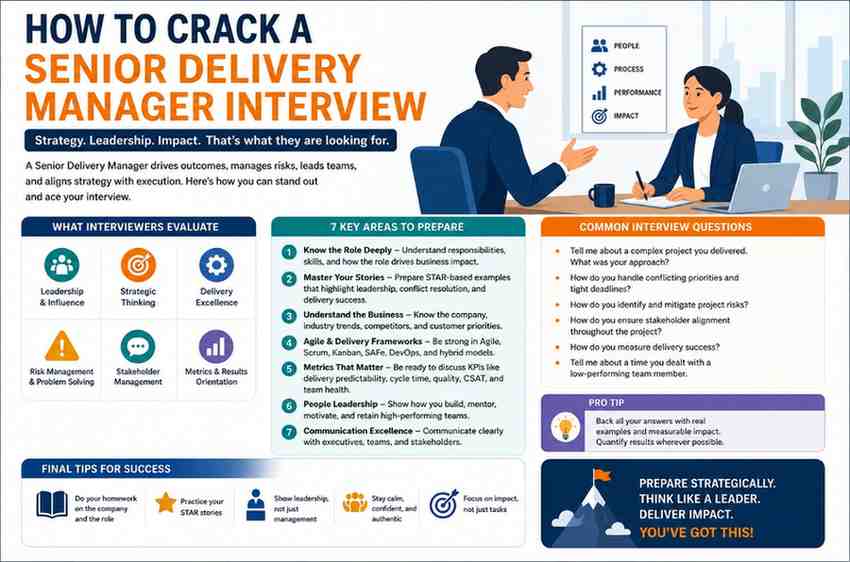
How to Crack a Senior Delivery Manager Interview– Getting a Senior Delivery Manager role is not just about showing up with a polished CV and reciting Agile buzzwords. Companies hiring at this level are looking for someone who can own complex, cross-functional programs end to end — keeping engineering, product, business stakeholders, and external vendors in lockstep while delivering measurable outcomes. The bar is genuinely high.
Whether you’re currently a Delivery Manager eyeing the next step, or a Program Manager transitioning into delivery-focused leadership, this guide gives you the concrete preparation you need — covering every phase of the interview process, the toughest questions you’ll face, and the frameworks that will make your answers land.
“Senior Delivery Manager interviews don’t test what you know — they test how you perform under ambiguity, and whether you can lead other humans through it.”
What Does a Senior Delivery Manager Actually Do?
Before you walk into the interview, you need crystal clarity on what this role demands. A Senior Delivery Manager is not a project coordinator who sends status updates. At senior level, you’re expected to set delivery strategy, manage dependencies across multiple teams, identify systemic risks before they become crises, and influence decisions at the VP level without direct authority.
🔀
Cross-team dependency management
🛡
Risk identification & mitigation
👥
📊
🔄
💬
Phase 1 — The Recruiter and Hiring Manager Screen
The first two conversations are about fit and calibration. Recruiters are checking whether your background maps to the job description. Hiring managers are deciding whether they’d want to work with you on their hardest problems. Neither call is trivial.
Recruiter screen (30 min)
Prepare a tight 90-second career narrative. Emphasize progression from delivery execution to delivery leadership. Quantify scope: number of teams, budgets owned, program sizes, outcomes achieved.
Can you operate at the senior level — or do you solve problems that your team should solve? The most disqualifying answer is showing up as a task manager, not a systems thinker.
Research the company’s delivery maturity before the recruiter call. Is it pre-SAFe chaos, mid-transition to Agile, or a scaled multi-team environment? Tailor every example you share to the maturity level they’re building toward.

Phase 2 — The Core Behavioral Interview
This is where most Senior Delivery Manager interviews are won or lost. Behavioral rounds at senior level are not looking for “I did X and it went well.” They’re looking for evidence of judgment: how you saw risk early, how you navigated political friction, and how your decisions led to outcomes that wouldn’t have happened without you.
The STAR-L Framework
Standard STAR (Situation, Task, Action, Result) is table stakes. For a senior role, add L — Learnings — to show that you operate with a growth mindset and have improved your approach over time. Senior leaders interview for judgment, not just outcomes.
Situation: Platform migration stalled across 4 teams with an immovable regulatory deadline.
Task: Get delivery back on track in 6 weeks.
Action: Ran a dependency mapping workshop, identified 3 critical blockers, negotiated re-scoping with product leadership, created a shared war-room cadence.
Result: Delivered 94% of committed scope on time; remaining 6% de-risked post-launch.
Learning: Formalized dependency mapping as a ritual for all programs above a certain complexity threshold.
The 15 Most Common Senior Delivery Manager Interview Questions
These questions appear across Google, Amazon, Spotify, Atlassian, and other top-tier hiring companies. Gururo coaches have tracked these patterns across hundreds of interview debriefs — these are the questions that consistently show up, and the lens interviewers use to evaluate each one.
Leadership & Influence
Tell me about a time you influenced a major delivery decision without having direct authority over the team.
Interviewer lens: Can you lead through influence rather than command? Do you understand stakeholder motivations?
Describe a situation where engineering and product were at an impasse. How did you resolve it?
Interviewer lens: Do you facilitate alignment or just escalate? Can you operate in the space between functions?
How do you manage a senior stakeholder who constantly changes priorities and disrupts your team’s flow?
Interviewer lens: Emotional intelligence, executive presence, and the ability to push back constructively
Delivery & Execution
Walk me through the most complex program you’ve delivered. What was your role, and what almost made it fail?
Interviewer lens: Scope of ownership, honest self-awareness, and how you navigate real complexity.
How do you track and manage cross-team dependencies at scale?
Interviewer lens: Systems thinking, tooling maturity, and whether you scale processes or just communicate harder.
Tell me about a delivery that failed or significantly missed its target. What happened and what did you change afterward?
Interviewer lens: Accountability, learning mindset, and whether you treat retrospectives as real inputs or box-ticking.
How do you know when to escalate versus when to resolve a blocker yourself?
Interviewer lens: Senior judgment — escalating too early signals insecurity; too late signals poor risk management.
Agile, Process & Methodology
How do you adapt your delivery approach when working with teams at different Agile maturity levels?
Interviewer lens: Pragmatism vs. dogma. Senior DMs meet teams where they are, not where the methodology says they should be.
What metrics do you use to assess the health of a delivery program?
Interviewer lens: Do you know the difference between vanity metrics and leading indicators? Expect a follow-up on how you act on the data.
How do you balance technical debt against feature delivery timelines?
Interviewer lens: Do you see this as an engineering problem or a delivery problem? (It’s both.)
Strategic & Senior-Level Thinking
How do you build a delivery roadmap for a program where requirements are still unclear?
Interviewer lens: Comfort with ambiguity, structured thinking, and iterative planning.
How do you build trust with a new engineering team that’s skeptical of delivery oversight?
Interviewer lens: Self-awareness about how DM roles are sometimes perceived, and emotional intelligence in building psychological safety.
What does “delivery done well” look like at the senior level versus the mid-level?
Interviewer lens: Self-awareness about what seniority actually means — strategic leverage, not just bigger tickets.
How do you build delivery capability in an organisation that lacks it?
Interviewer lens: Can you raise the floor, not just manage the ceiling? Change management and coaching skills matter here.
Where do you see the role of the Delivery Manager evolving over the next three years?
Interviewer lens: Vision, industry awareness, and genuine thought leadership. This question is often used to separate strong from exceptional candidates.
What Great Answers Look Like — Real Examples
Stakeholder conflict example
A product VP kept adding scope three sprints from launch. Rather than just saying no, I asked to get fifteen minutes with them and their director together. I built a simple impact model — what each addition would cost in time, what risk it created, and what the team would need to drop. Once the trade-off was visible and the director was in the room, the VP voluntarily deprioritised two of the three items. The third we took forward but negotiated a one-sprint extension with an explicit sign-off from both leaders. No drama, documented outcome.
Metrics example
The metrics I track at program level are cycle time trends (not velocity — velocity is a team metric, not a delivery metric), dependency resolution rate, and the number of decisions stuck in the escalation queue for more than five days. That last one is often the most honest leading indicator of whether a program is going to slip.
Pre-Interview Preparation Checklist
Use this checklist in the 48 hours before your interview. Gururo‘s preparation frameworks are built around this exact structure — candidates who work through all seven points before their panel consistently report feeling significantly more confident and composed.
- Prepare three STAR-L stories covering: a delivery under pressure, a cross-functional conflict resolved, and a systemic improvement you drove.
- Research the company’s current delivery challenges — check their engineering blog, recent job postings (they signal pain points), and any public postmortems or engineering culture content.
- Be ready to talk through your delivery toolset: what you use for roadmapping, dependency tracking, risk logs, and reporting — and why you chose each one.
- Prepare a crisp answer to “What’s your delivery philosophy?” — ideally in under 90 seconds, with a concrete example embedded.
- Prepare five sharp questions for the panel — at least two should be about delivery maturity, team structure, or specific challenges the role will be expected to solve.
- Practice out loud, not in your head. Behavioral interview answers that sound natural in writing often sound scripted when spoken. Record yourself at least once.
- Review the job description one more time and map each listed responsibility to a specific story or example from your background.
Common Mistakes That Cost Candidates the Role
After reviewing hundreds of hiring debrief notes from senior delivery manager panels, the same failure modes appear repeatedly:
Talking about the team’s work instead of your own judgment. Saying “we delivered the platform migration on time” tells the interviewer nothing about you. What did you specifically see, decide, and do that a more junior person would have missed?
Answering at the wrong altitude. Senior DM interviews reward strategic and systems-level thinking. If every answer is about sprint ceremonies or Jira board hygiene, you’re presenting at the wrong level.
Avoiding the hard stories. Candidates who only share successes come across as either inexperienced or dishonest. The failure questions are not traps — they are your biggest opportunity to show growth mindset, accountability, and resilience.
Not asking good questions. “What does success look like in the first 90 days?” is fine, but it’s table stakes. The best candidates ask questions that reveal they’ve already thought deeply about the company’s specific delivery challenges.
Real Delivery Manager Interview Questions Shared by Candidates–
The single most powerful thing you can do in a Senior Delivery Manager interview is demonstrate that you think in systems, not tasks. Every answer should show that you understand the upstream and downstream implications of your decisions — not just whether the sprint went green.
FAQs
What is the role of a Senior Delivery Manager?
A Senior Delivery Manager is responsible for leading large-scale software delivery programs while ensuring alignment between engineering execution, business priorities, and customer expectations. The role goes far beyond project tracking or sprint coordination.
Senior Delivery Managers oversee cross-functional teams, manage delivery risks and escalations, drive stakeholder alignment, improve delivery predictability, and ensure strategic business outcomes are achieved within timelines and quality standards. They often work closely with engineering leaders, product managers, executives, clients, and operations teams to maintain delivery excellence at scale.
Are technical questions asked in Senior Delivery Manager interviews?
Yes. While Senior Delivery Managers are usually not expected to write production-level code during interviews, companies strongly evaluate technical understanding and delivery awareness.
Interviewers commonly assess knowledge of system architecture, microservices, APIs, cloud platforms, DevOps pipelines, release management, incident handling, scalability challenges, and Agile delivery frameworks. The goal is to ensure candidates can make informed delivery decisions, communicate effectively with engineering teams, and manage technical risks confidently.
What are the most important skills for Senior Delivery Managers?
The most important skills include delivery leadership, stakeholder management, risk mitigation, Agile execution, executive communication, team leadership, dependency management, and metrics-driven decision-making.
Successful Senior Delivery Managers are expected to balance strategic thinking with operational execution. Companies look for professionals who can lead teams through uncertainty, resolve escalations calmly, align competing priorities, and deliver measurable business impact consistently.
How should I answer behavioral questions in a Senior Delivery Manager interview?
The best approach is to use the STAR-L framework:
- Situation
- Task
- Action
- Result
- Learning
Strong behavioral answers focus on real delivery challenges, leadership decisions, stakeholder communication, risk handling, and measurable business outcomes. Instead of giving theoretical answers, candidates should explain how they handled complex situations, influenced teams, resolved conflicts, and improved delivery performance.
What is the best way to prepare for a Senior Delivery Manager interview?
The most effective preparation strategy combines leadership storytelling, Agile and technical revision, mock interviews, and company-specific research.
Candidates should prepare detailed STAR-L examples around delivery challenges, stakeholder conflicts, escalation management, and cross-functional leadership. It is equally important to practise executive-level communication, understand delivery metrics and KPIs, and research the company’s products, engineering culture, and delivery processes before the interview.
Conclusion
Cracking a Senior Delivery Manager interview is rarely about memorising perfect answers or reciting Agile terminology. Senior-level interviews are designed to evaluate something much deeper — your judgment under pressure, your ability to lead through ambiguity, and the way you think about delivery as a business function rather than a project checklist.
The strongest candidates are not the ones with the most polished scripts. They are the ones who can clearly articulate how they handled complex delivery challenges, aligned competing stakeholders, managed escalations, influenced decisions without authority, and created predictable execution in environments filled with uncertainty.
At this level, interviewers are looking for evidence of leadership maturity. They want to understand how you make decisions when priorities conflict, how you communicate during delivery crises, and whether engineering teams, business leaders, and clients trust your ability to drive outcomes consistently.
That is why preparation matters far beyond rehearsing answers.
Candidates who consistently succeed in Senior Delivery Manager interviews usually prepare in a structured way. They map their experience directly to the role requirements, build high-quality STAR-L stories backed by measurable business impact, and practise discussing delivery strategy, operational risks, stakeholder alignment, and execution trade-offs with executive-level clarity.
Platforms like Gururo provide structured mock interview programmes specifically designed for Delivery Managers and Program Managers, helping candidates simulate real interview environments, improve communication depth, and receive feedback from experienced industry leaders who understand exactly how senior hiring decisions are made.
Go into the interview prepared to demonstrate leadership, not just coordination.
Lead with clarity.
Communicate with confidence.
Speak in terms of business impact.
And most importantly, tell the stories that prove you were already operating at a senior leadership level long before the title officially arrived.