How to set up a PMO from Scratch in 2026 is one of the most critical challenges organizations face as they scale project delivery and strategic execution. Despite the growing need, only 58% of organizations have a functioning Project Management Office — and nearly one-third of PMO implementations fail within the first two years. The primary reason is not budget constraints, but poor planning, unclear mandates, and weak governance structures from the beginning.
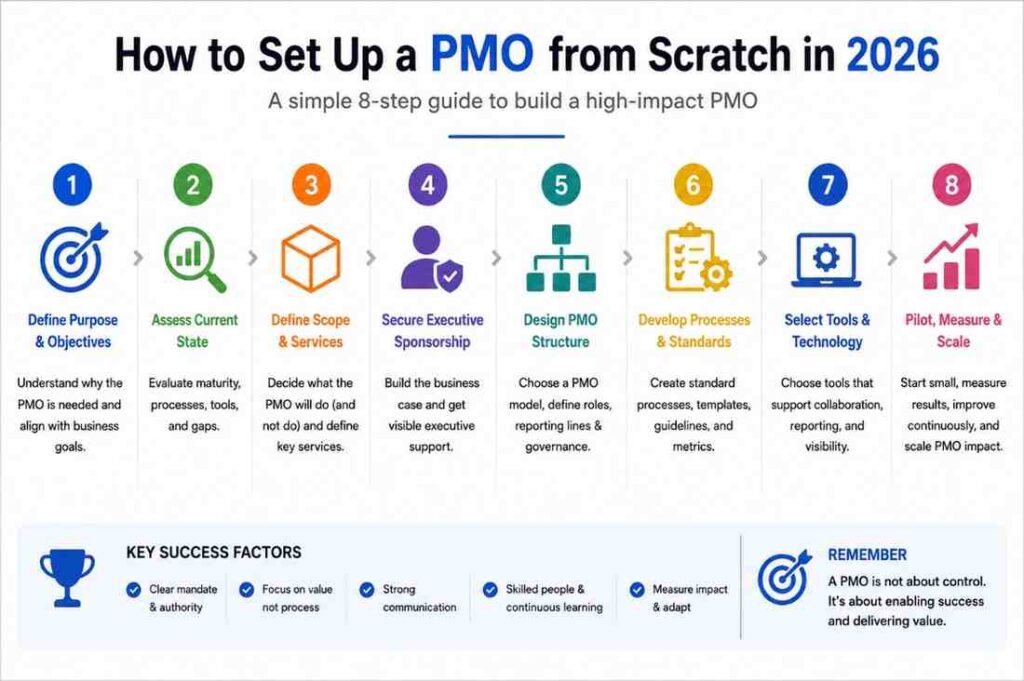
If you are wondering How to Set Up a PMO from Scratch in 2026 effectively, this guide provides a complete, step-by-step roadmap. Whether you are tasked with building a PMO from scratch or proposing one within your organization, you will learn how to choose the right PMO type, define clear roles and responsibilities, establish a strong governance framework, and implement KPIs that demonstrate measurable business value.
Understanding how to set up a PMO in 2026 also means aligning project execution with organizational strategy. This guide is designed for program managers, PMO leaders, and professionals preparing for certifications who want a practical, real-world approach — not just theoretical concepts.
What Is a PMO and Why Most Organizations Get It Wrong When Trying to Set Up a PMO and How to Set Up a PMO
A Project Management Office (PMO) is an organizational function that standardizes project governance, creates consistent delivery practices, and ensures strategic alignment across an organization’s project portfolio. It is not a bureaucratic checkpoint or a reporting layer — it is a delivery enabler.
The most common mistake is treating a PMO as a documentation unit. When a PMO is reduced to collecting status reports and tracking milestones, it loses credibility fast. Executives defund it. Project teams route around it. The PMO collapses.
The second-most common mistake is building the wrong type of PMO for the organization’s maturity level. There are three foundational PMO models:
- Supportive PMO: Provides templates, tools, training, and guidance. Low control. Works well in organizations with strong autonomous teams.
- Controlling PMO: Requires compliance with specific methodologies and frameworks. Moderate control. Best for mid-size enterprises scaling delivery capability.
- Directive PMO: Directly manages projects and assigns resources. High control. Suited for mature enterprises or organizations with complex, interdependent programs
Before you draft a single org chart or governance document, you must determine which model fits your organization — based on culture, leadership appetite for control, and current PM maturity.
How to Define Your PMO Mandate Before Anything Else
The PMO mandate is the single most important document you will write. It defines what the PMO is authorized to do, what it is accountable for, and what it is not responsible for. Without a clear mandate, every stakeholder will have a different expectation — and you will spend your first six months firefighting misalignments.
A strong PMO mandate should address five areas:
- Scope of authority: Which projects, programs, or portfolios fall under the PMO?
- Decision rights: What can the PMO decide independently? What requires escalation?
- Relationship to business units: Does the PMO serve business units, or does it have authority over them?
- Reporting lines: Does the PMO Director report to the CTO, COO, or CEO? This determines political weight.
- Success definition: How will the PMO be evaluated at 6 months, 12 months, and 3 years?
The mandate must be signed off by a C-suite sponsor before the PMO officially launches. Without that executive signature, the PMO will struggle to enforce governance or gain access to portfolio data.
Staffing Your PMO: Roles, Hierarchy, and Hiring Order
One of the fastest ways to understaff a PMO is to hire for credentials before clarifying function. The right PMO team structure depends on the PMO type and organizational size, but here is a proven hiring order for a new PMO launch:
Core PMO Roles
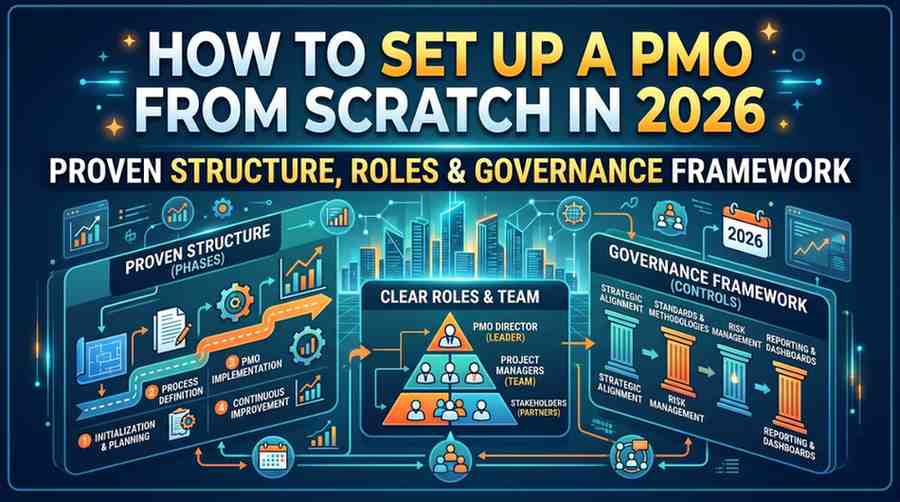
- PMO Director / Head of PMO: Sets strategy, manages executive relationships, owns the mandate. This hire defines everything else.
- PMO Analyst / Coordinator: Manages data, dashboards, reporting cadence, and tool administration.
- Portfolio Manager: Tracks interdependencies across projects, manages resource allocation at the portfolio level.
- Process / Methodology Lead: Owns the standards, templates, and delivery framework. Often a certified PMP or PgMP holder.
- Change Management Lead: Manages stakeholder adoption and communication as the PMO rolls out new processes.
For organizations setting up a PMO for the first time, begin with the Director + one Analyst + one Process Lead. Scale from there as portfolio volume grows. Overstaffing a new PMO before it has proven value is a common political mistake that accelerates defunding.
Building the PMO Governance Framework
Governance is the operating system of your PMO. Without it, decisions stall, accountability blurs, and project teams bypass the PMO entirely. A PMO governance framework defines how decisions are made, who makes them, and how oversight is maintained without creating bureaucratic friction.
Key Governance Components
- Steering Committee: Senior leaders who review portfolio health, approve prioritization decisions, and resolve cross-functional conflicts. Meets monthly or quarterly.
- Decision Rights Matrix (RACI): A documented matrix that maps decisions to roles — who is Responsible, Accountable, Consulted, and Informed. This eliminates gray areas.
- Escalation Path: A defined ladder for issues that cannot be resolved at the project or program level. The PMO is typically the second escalation tier.
- Reporting Cadence: Weekly status reports from project managers, biweekly portfolio dashboards for the PMO, monthly executive summaries.
- Stage Gate Reviews: Formal checkpoints at key project phases where the PMO reviews deliverables and authorizes progression. Prevents resource waste on failing projects.
The governance framework must be proportionate. A PMO that requires twelve sign-offs for a minor scope change will be bypassed on day one. Design governance to protect strategic value — not to control every micro-decision.
KPIs That Prove PMO Value to Leadership
A PMO that cannot demonstrate value will not survive its first budget cycle. The key is to define KPIs before launch — not after — so that baselines exist for comparison.
Key Governance Components
The following KPIs are recognized by PMI and widely used across enterprise PMOs:
- On-Time Delivery Rate: Percentage of projects delivered within the agreed schedule baseline. Target: above 80%.
- Budget Variance: Difference between planned and actual spend across the portfolio. A PMO that reduces budget overruns by 15% in Year 1 has a clear ROI story.
- Resource Utilization Rate: How effectively human capital is allocated across active projects. Idle capacity and over-allocation both represent losses.
- Stakeholder Satisfaction Score: Quarterly survey of project sponsors and business unit leads on PMO responsiveness and value-add.
- Benefits Realization Rate: Percentage of promised project outcomes that are actually delivered post-closure. This is the metric that separates delivery-focused PMOs from reporting PMOs.
Connect these KPIs directly to organizational strategy. If the company’s top priority is reducing time-to-market, your primary PMO KPI should be schedule performance. Alignment to strategy is what earns the PMO a permanent seat at the executive table.
The First 90 Days: A PMO Launch Plan That Works
The first 90 days of a PMO launch are the highest-risk period. You are building credibility while simultaneously building infrastructure. Move too fast and you create chaos. Move too slow and stakeholders lose confidence.
Days 1–30: Discovery and Foundation
- Conduct stakeholder interviews across all business units to understand current pain points, expectations, and existing PM practices.
- Inventory all active projects — scope, budget, timeline, sponsor, and PM — to establish the portfolio baseline.
- Finalize and publish the PMO mandate with executive sign-off.
- Select and configure the core PMO tool (Microsoft Project Online, Smartsheet, Planview, or similar).
Days 31–60: Framework Build
- Publish the PMO Governance Framework and RACI Matrix.
- Introduce standardized project templates: charter, status report, risk register, change log.
- Conduct a half-day PMO onboarding session for all active project managers.
- Schedule the first Steering Committee meeting and present the portfolio health baseline.
Days 61–90: Optimization and Visibility
- Launch the portfolio dashboard — a single view of all projects by health status, milestone, and budget variance.
- Identify the two or three highest-risk projects and deploy PMO support directly to those teams.
- Publish the 90-day PMO report: what was found, what was built, what will be measured, and what comes next.
Professionals preparing for PgMP or PMP certification will find this 90-day structure closely aligned with the PMI Standard for Program Management — making it both operationally sound and exam-relevant. Platforms like Gururo offer program management practice tests and study resources that reinforce these governance concepts in exam-ready format.
👉To know more click here : More blogs
Common PMO Setup Mistakes and How to Avoid Them
Even experienced program managers make predictable errors when standing up a new PMO. Awareness is the first line of defense.
Starting with tools before process: No project management software fixes a broken governance model. Define the process first; then select tools that support it.
Skipping the mandate: A PMO without a signed mandate will be constantly challenged by business units who prefer autonomy. Get executive sponsorship in writing.
Hiring for certification instead of capability: A room full of PMPs does not make a high-functioning PMO. Hire for communication, systems thinking, and political savvy — then layer in credentials.
Measuring activity instead of outcomes: Reporting the number of status meetings held is not a PMO value metric. Measure delivery performance, budget adherence, and strategic benefit realization.
Ignoring change management: The PMO is a change to how people work. Without deliberate change management — communication, training, and stakeholder buy-in — resistance will undermine every governance effort.
Have you been tasked with setting up a PMO and found any of these challenges already emerging? The earlier you address them, the easier the course correction.
Key Takeaways
- A PMO’s success depends on selecting the right type — supportive, controlling, or directive — based on organizational maturity, not preference.
- The PMO mandate must be signed by a C-suite sponsor before launch. Without it, governance lacks authority.
- Hire in order: Director first, then Analyst and Process Lead. Avoid overstaffing before the PMO has proven value.
- Governance frameworks should protect strategic decisions — not control every micro-action.
- Define KPIs before launch. Use on-time delivery, budget variance, and benefits realization to build the ROI case.
- The first 90 days are your credibility window. Move with structure and communicate progress constantly.
Frequently Asked Questions (FAQs)
1. What is a PMO in project management?
A Project Management Office (PMO) is a centralized team or function that standardizes project processes, ensures governance, and aligns projects with business goals to improve overall delivery performance.
2. Why is a PMO important for organizations?
A PMO is important because it improves project success rates, ensures consistent processes, reduces risks, and aligns all projects with strategic business objectives, helping organizations deliver better results.
3. How do you set up a PMO from scratch in 2026?
To set up a PMO, you need to define the PMO type, create a clear mandate, hire key roles like PMO Director and Analyst, build a governance framework, and implement KPIs to measure success.
4. What are the different types of PMO?
There are three main types of PMOs:
- Supportive PMO (low control)
- Controlling PMO (moderate control)
- Directive PMO (high control)
Each type depends on the organization’s maturity and needs.
5. What are the key roles and responsibilities in a PMO?
Key PMO roles include PMO Director, PMO Analyst, Portfolio Manager, Process Lead, and Change Manager. These roles ensure governance, reporting, project alignment, and successful execution.